Understanding Angkor as a living royal city, not just a set of temples
Temples and ruinsType
In short
Angkor Thom is the walled royal city built by King Jayavarman VII in the late 12th century, the last and largest capital of the Khmer Empire. It covers 9 square kilometres inside 8 metre walls and a moat, entered through five face-tower gates, and contains the Bayon, the Baphuon, Phimeanakas and the royal terraces. The South Gate, with its causeway of 54 gods and 54 demons holding a serpent, is the famous way in, and entry is covered by the Angkor Pass.
About 1.7 km north of Angkor Wat, Angkor Archaeological Park, Siem Reap
Built
Late 12th century by King Jayavarman VII, with older temples inside
Size
9 square kilometres, with walls 3 km long on each side and 8 m high
Gates
Five: north, south, east, west and the Victory Gate
Ticket
Covered by the Angkor Pass ($37 for 1 day, $62 for 3 days, $72 for 7 days)
Opening hours
Temples inside reported open 6:00 am to 6:30 pm; confirm locally
Time needed
Half a day for the South Gate, Bayon, Baphuon and terraces
Best time
Opening time, before the post-sunrise tour groups
Inside the walls
Bayon, Baphuon, Phimeanakas, Terrace of the Elephants, Terrace of the Leper King
Getting around
Tuk-tuk, bicycle or on foot; the roads inside are flat
Angkor Thom, the “great city”, was the last and grandest capital of the Khmer Empire, a walled and moated royal city of nine square kilometres built by King Jayavarman VII in the late 12th century. You enter it through the South Gate, crossing a causeway lined with stone gods and demons beneath a tower of giant faces, and inside lie the Bayon, the Baphuon and the royal terraces.
Late 12th centuryFounded by Jayavarman VII
9 km²Area inside the walls
3 kmLength of each wall
5Monumental gates
23 mHeight of the gate towers
Many visitors confuse Angkor Thom with Angkor Wat. Angkor Wat is a single temple. Angkor Thom is a whole city, a little over a kilometre and a half to the north, where the king, his court and thousands of officials once lived. The wooden palaces and houses have long gone, but the stone temples and terraces that stood among them remain.
History of Angkor Thom
Mid-11th century
Parts of the later city already exist. The Baphuon temple mountain rises on what will become the royal enclosure, near the older palace temple of Phimeanakas.
1177
A Cham army sacks the Khmer capital, a shock that shapes everything that follows.
1181 onwards
Jayavarman VII drives out the Cham, takes the throne and builds a new fortified capital. He surrounds it with a laterite wall 8 metres high and a wide moat, and places the Bayon at its exact centre.
1296 to 1297
The Chinese envoy Zhou Daguan spends about a year here. His account is the only eyewitness description of daily life in the Khmer capital to survive.
1431
Forces from the Thai kingdom of Ayutthaya sack Angkor. Over the following period the royal court moves south towards Phnom Penh, and the city is gradually abandoned to the forest.
20th century to today
French, Cambodian and international teams clear and restore the monuments. The Baphuon, dismantled in the 1960s and left in pieces during the civil war, is finally reassembled in 2011.
The South Gate and its causeway
Five great gates pierce the walls of Angkor Thom: one at each point of the compass and a fifth, the Victory Gate, on the east side leading straight to the royal palace. The South Gate is the best preserved and the one almost everyone uses, because it is on the road from Angkor Wat and Siem Reap.
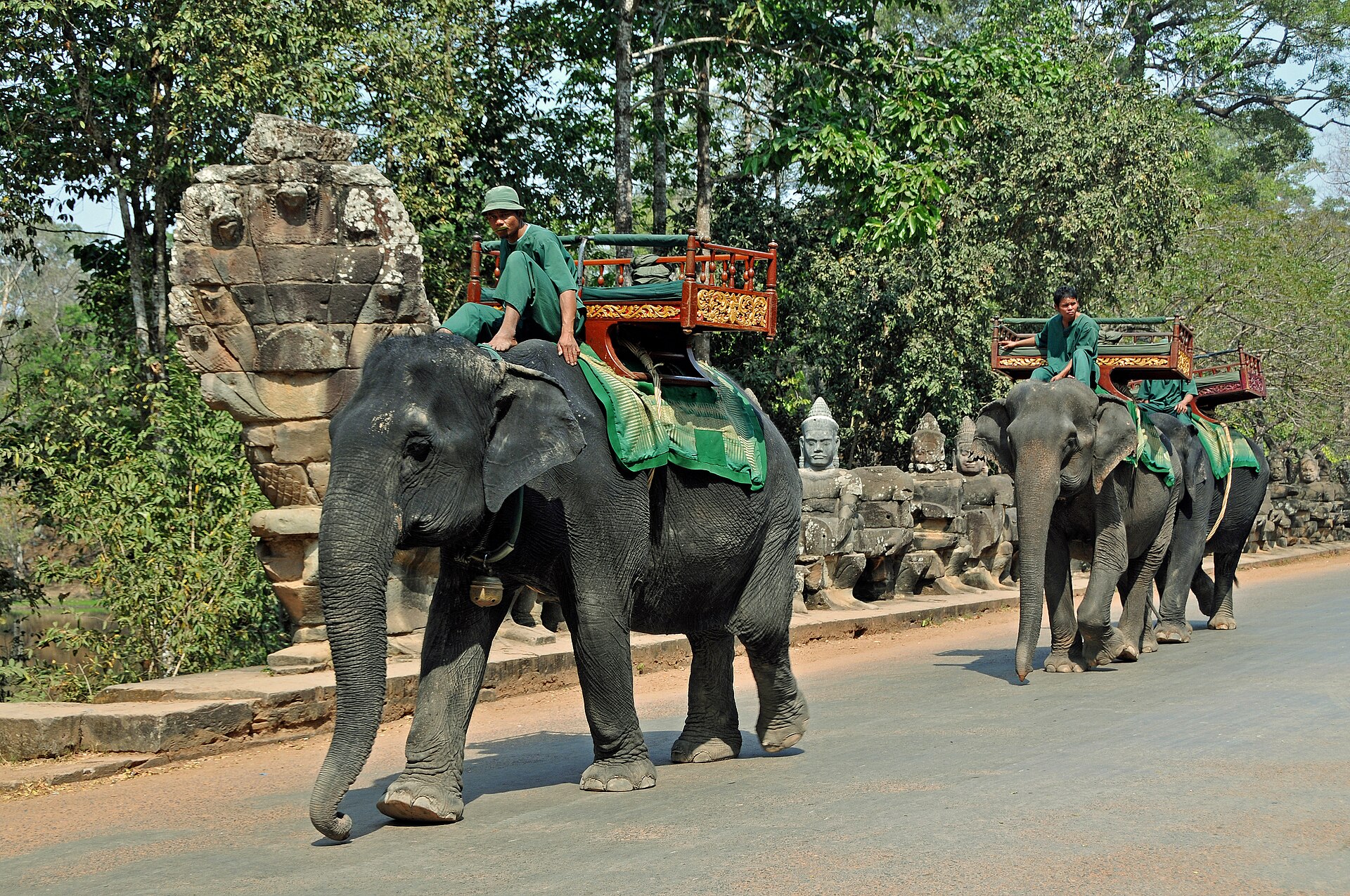
The causeway across the moat is lined on each side with 54 giant figures holding the body of a serpent, or naga. On the left are the calm-faced devas, or gods; on the right the scowling asuras, or demons. Together they recreate the Hindu myth of the Churning of the Ocean of Milk, the tug of war between gods and demons that produced the elixir of immortality. The causeway itself becomes the rainbow bridge between the world of people and the world of the gods.
The gate tower rises 23 metres and carries four faces looking out to the four directions, the same faces you will meet again at the Bayon. At its base, three-headed elephants of the god Indra pluck lotus flowers with their trunks. Many of the heads on the causeway are replacements; originals have been stolen or moved to museums over the years.
Our advice
Get out and walk. Ask your driver to drop you before the causeway and pick you up inside the gate. You see far more on foot.
Come early or late. The gate is a bottleneck for traffic and tour buses. Before 8:00 am or after 4:00 pm it is far calmer.
Look at the moat side. From the bank beside the causeway you get the classic view of the gate reflected in the water.
What to see inside the walls
The centre
The Bayon
Jayavarman VII’s state temple, with about 200 serene stone faces and the liveliest reliefs at Angkor. Read our full Bayon guide.
Temple mountain
The Baphuon
A towering 11th-century pyramid dedicated to Shiva. On its west side, a vast reclining Buddha was added later in stone. The steep climb rewards you with views over the treetops.
Royal enclosure
Phimeanakas
A small, steep temple inside the walled palace grounds. Zhou Daguan recorded the legend that the king spent part of each night here with a serpent spirit in the form of a woman.
Ceremonial stage
Terrace of the Elephants
A 350 metre long platform from which the king watched parades and received his returning army, carved with life-size elephants, garudas and lions.
Mystery
Terrace of the Leper King
A high terrace with walls of carved deities and serpents, and a hidden inner wall you can walk along. The statue on top is a copy; the original is in the National Museum in Phnom Penh.
Quieter corners
Preah Palilay and the Kleangs
A small, tree-shaded temple north of the royal palace, and the two long stone buildings facing the royal square across a row of twelve towers, the Prasat Suor Prat.
Tickets and opening hours
Ticket
Covered by the Angkor Pass: 1 day $37, 3 days $62 (use within 7 days), 7 days $72 (use within 30 days)
Where to buy
Angkor ticket office on Road 60, or online through Angkor Enterprise
Children
Under 12 free; bring a passport as proof of age
Opening hours
Daily; the temples inside are reported to open 6:00 am to 6:30 pm. Confirm locally
Time needed
Half a day for the South Gate, Bayon, Baphuon and terraces
Getting around
Flat roads, ideal for bicycle or tuk-tuk; the monuments themselves have steep steps
A half day in Angkor Thom
This route follows the city from south to north and ends near the North Gate or Victory Gate, where your driver can meet you:
7:30 am Walk across the South Gate causeway and through the gate
8:00 am The Bayon: outer gallery reliefs, then the face towers, about 90 minutes
9:30 am Walk north to the Baphuon along its raised causeway, and climb if you are able
10:30 am Phimeanakas and the royal enclosure, then out onto the Terrace of the Elephants
11:15 am The Terrace of the Leper King and its hidden inner wall
11:45 am Exit through the Victory Gate towards Ta Prohm, or return to Siem Reap for lunch
With more time, add Preah Palilay, Tep Pranam and the Kleangs, or walk a stretch of the city wall, which has a shaded path along its top.
Best time to visit
Start early. Tour groups usually move from Angkor Wat to Angkor Thom after sunrise, so the South Gate and the Bayon fill from about 9:00 am. If you skip the sunrise and come straight to the South Gate at opening time, you will enjoy an hour of quiet. Late afternoon is lovely too, when the stone warms to gold.
November to February is the coolest and driest season. From March to May it is very hot, so plan the open terraces for early morning. The green season from June to October brings fewer visitors, a full moat and dramatic skies, with showers usually in the afternoon.
Tips and etiquette
Please do
Cover your shoulders and knees, especially for the Bayon and Baphuon
Carry your Angkor Pass; it is checked at several monuments
Bring water, a hat and sun cream for the open terraces
Consider a bicycle; distances inside the walls are ideal for cycling
Please don’t
Sit or climb on the causeway figures or the naga
Climb closed staircases or step over barriers
Touch the carvings on the terraces
Feed or tease the monkeys near the South Gate
The climbs. The Baphuon and Phimeanakas have steep, narrow stairs. Upper levels may close in wet weather or on Buddhist holy days, and some have age or dress rules at the entrance.
How to get there
The South Gate is about 1.7 kilometres north of Angkor Wat along the main park road, and roughly 20 to 25 minutes by tuk-tuk from central Siem Reap. Most visitors combine Angkor Thom with Angkor Wat and Ta Prohm on the classic “small circuit” day. From the Victory Gate, the road leads east to Ta Keo and Ta Prohm; from the North Gate, it continues to Preah Khan.
Visiting with My Travel Factory
We plan your Angkor Thom morning so you cross the South Gate causeway before the crowds, with a Khmer guide who brings the royal city back to life, from the parades on the Terrace of the Elephants to the markets carved on the Bayon. It is part of our Cambodia Classic Highlights and Phnom Penh & Angkor Discovery, and we can add a cycling day through the city on any trip. Send us an enquiry to start planning.
Questions travellers ask
What is Angkor Thom?
Angkor Thom is the walled royal city built by King Jayavarman VII in the late 12th century. It was the last great capital of the Khmer Empire and contains the Bayon, the Baphuon and the royal terraces.
Is Angkor Thom the same as Angkor Wat?
No. Angkor Wat is a single temple. Angkor Thom is a walled city about 1.7 km north of it, containing several temples and terraces. Both are covered by the same Angkor Pass.
How big is Angkor Thom?
It covers about 9 square kilometres. Each side of the wall is 3 km long and 8 metres high, and the city is surrounded by a wide moat.
How many gates does Angkor Thom have?
Five. There is one at each point of the compass, plus the Victory Gate on the east side, which leads to the royal palace.
What is on the South Gate causeway?
Each side is lined with 54 giant figures holding a serpent: gods on the left and demons on the right. They represent the Churning of the Ocean of Milk from Hindu mythology.
Do I need a separate ticket for Angkor Thom?
No. Angkor Thom and everything inside it is covered by the Angkor Pass, which costs $37 for one day, $62 for three days and $72 for seven days.
How long do you need at Angkor Thom?
Allow half a day to see the South Gate, the Bayon, the Baphuon and the two terraces at a comfortable pace.
Can you cycle around Angkor Thom?
Yes, and it is one of the best ways to explore it. The roads are flat and shaded, and bicycles and e-bikes are easy to hire in Siem Reap.
What is the Terrace of the Elephants?
A 350 metre long ceremonial platform built by Jayavarman VII, from which the king watched parades. It is carved with elephants, garudas and lions.
When was Angkor Thom abandoned?
After Ayutthaya's forces sacked Angkor in 1431, the royal court gradually moved south towards Phnom Penh and the city was slowly abandoned.
Banteay Kdei is a late 12th-century Buddhist monastery temple in the Angkor Archaeological Park, built by King Jayavarman VII in the Bayon style. It lies just…
Where
Small Circuit, Angkor Archaeological Park, just east of Ta Prohm
Cambodia Wildlife Sanctuary is an elephant rescue and forest conservation project about 100 km north of Siem Reap, developed with the Save Elephant Foundation. It protects…
Where
About 100 km north of Siem Reap, on the edge of Kulen Promtep Wildlife Sanctuary