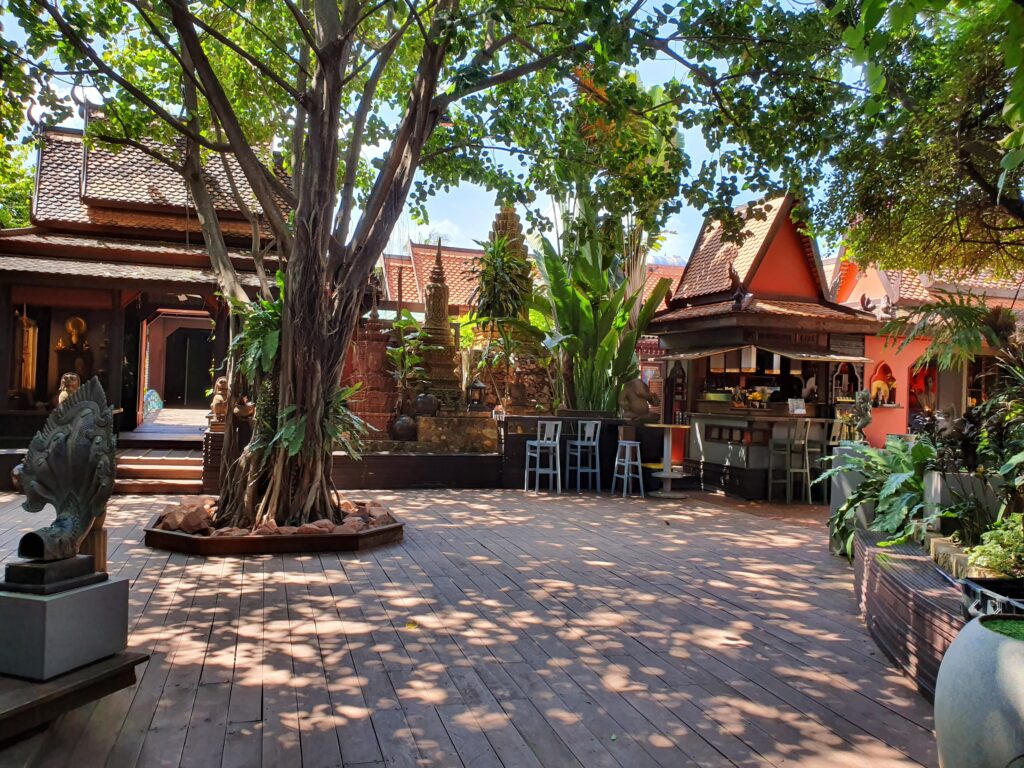
A quieter second day at Angkor, with trees and ruins to explore
Temples and ruinsType
In short
Preah Khan is a large 12th-century temple just north-east of Angkor Thom, dedicated in 1191 by King Jayavarman VII to his father. It served as a temple, Buddhist university and royal city, and today it is a partly ruined complex of long galleries, trees growing through the stone and a unique two-storey columned building. It is covered by the Angkor Pass and is much quieter than Ta Prohm, with most visitors spending one to two hours.
Just beyond the North Gate of Angkor Thom, on the grand circuit, Siem Reap
Built
Late 12th century by King Jayavarman VII; main image dedicated 1191
Dedicated to
The king's father, as the bodhisattva Avalokiteshvara
Original name
Nagara Jayasri, holy city of victory
Ticket
Covered by the Angkor Pass ($37 for 1 day, $62 for 3 days, $72 for 7 days)
Opening hours
Daily, reported as 6:00 am to 6:30 pm; confirm locally
Time needed
One to two hours
Best time
Early morning or late afternoon; quiet most of the day
Don't miss
The garuda wall, the two-storey building and the Hall of Dancers
Combine with
Neak Pean, Ta Som, East Mebon and sunset at Pre Rup
Preah Khan is a vast, atmospheric 12th-century temple just north-east of Angkor Thom, built by King Jayavarman VII in honour of his father. Part monastery, part university and part royal city, Preah Khan has the tumbled galleries and strangling trees of Ta Prohm with a fraction of the crowds, and a long central corridor of doorways that seems to run on forever.
1191Year of dedication
Jayavarman VIIThe king who built it
72Giant garudas on the outer wall
97,840Attendants named in its stele
1 to 2 hoursTime to allow
If you have loved Ta Prohm but found it busy, Preah Khan is the answer. It is larger, flatter and far quieter, with just enough restoration to walk through safely and enough ruin to feel like exploration. It sits on the “grand circuit” loop, so many first-time visitors miss it altogether.
History of Preah Khan
Late 12th century
Jayavarman VII, fresh from driving the Cham out of Angkor, builds Preah Khan on or near the site of a victory. Its original name, Nagara Jayasri, means “holy city of victory”. The modern name means “sacred sword”.
1191
The main image is dedicated: the bodhisattva Avalokiteshvara, portrayed in the likeness of the king’s father, Dharanindravarman II. Ta Prohm, five years earlier, had honoured his mother in the same way.
1190s
Preah Khan works as a city, temple and Buddhist university. Its foundation stele lists 97,840 attendants and servants, including 1,000 teachers and 1,000 dancers, and 430 deities with their own shrines. It may also have housed the king while Angkor Thom was being built.
13th century onwards
Under later Hindu kings, many Buddha images are chiselled away. Shrines to Shiva and Vishnu within the complex survive, reflecting its mixed religious life.
1991 to today
The World Monuments Fund begins conservation, choosing to stabilise the temple as a partial ruin rather than rebuild it. Its work continues with the APSARA National Authority.
What to see
The approach
The garuda wall and causeway
A causeway lined with gods and demons holding a serpent crosses the moat, echoing the gates of Angkor Thom. The outer wall is guarded by 72 giant garudas grasping serpents, set at regular intervals.
Unique at Angkor
The two-storey building
North-east of the centre stands a building with round columns and an upper floor, unlike anything else at Angkor. Its purpose is still debated; one idea is that it held a sacred relic.
Ceremony
The Hall of Dancers
A pillared hall on the east side with friezes of dancing apsaras along its lintels. It is easy to imagine music and dance filling the space.
The heart
The central stupa
The main sanctuary now holds a bell-shaped stone stupa, added centuries later in place of the original statue. Holes in the walls may once have held bronze plates.
Atmosphere
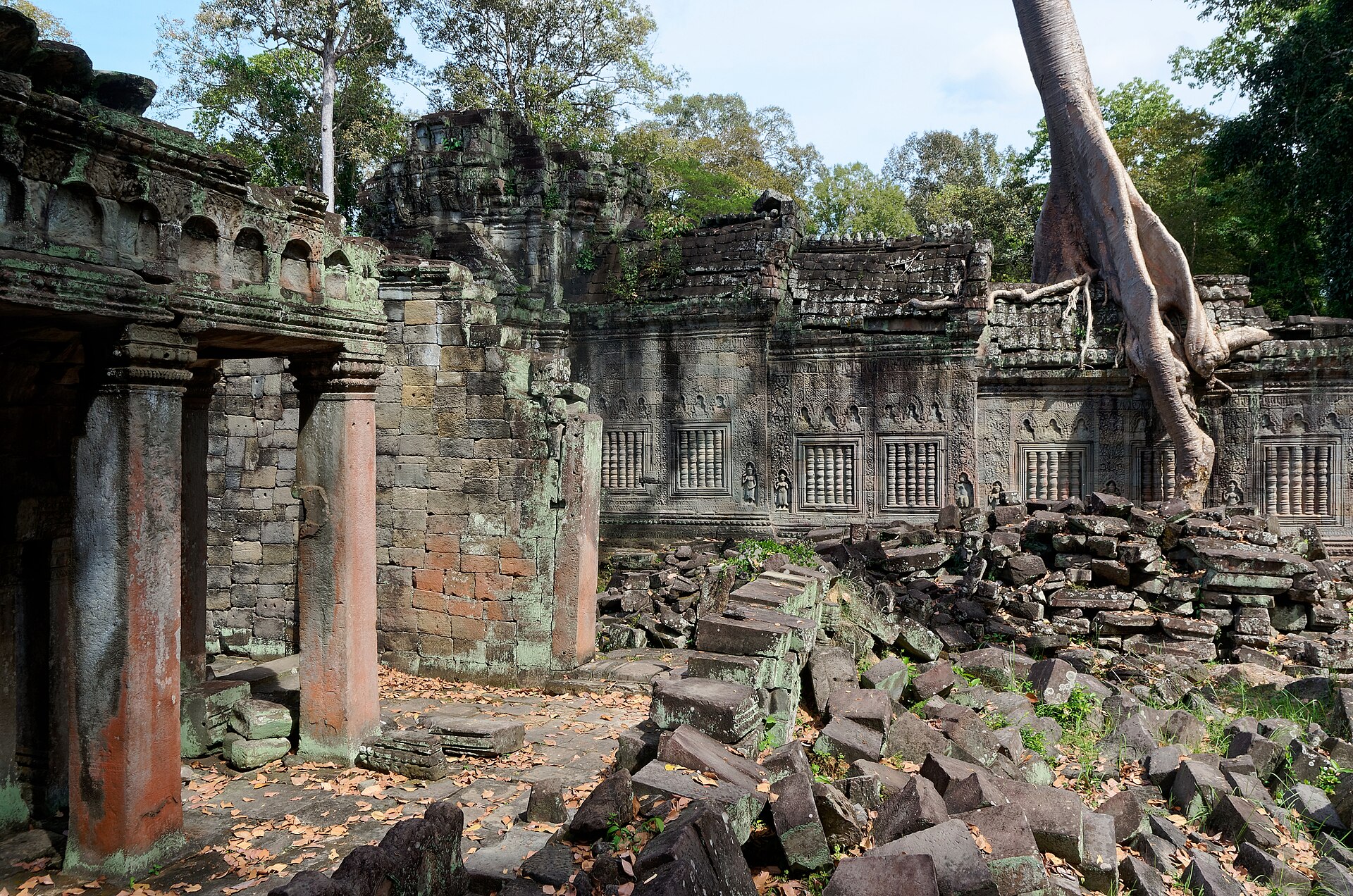
Trees through the stone
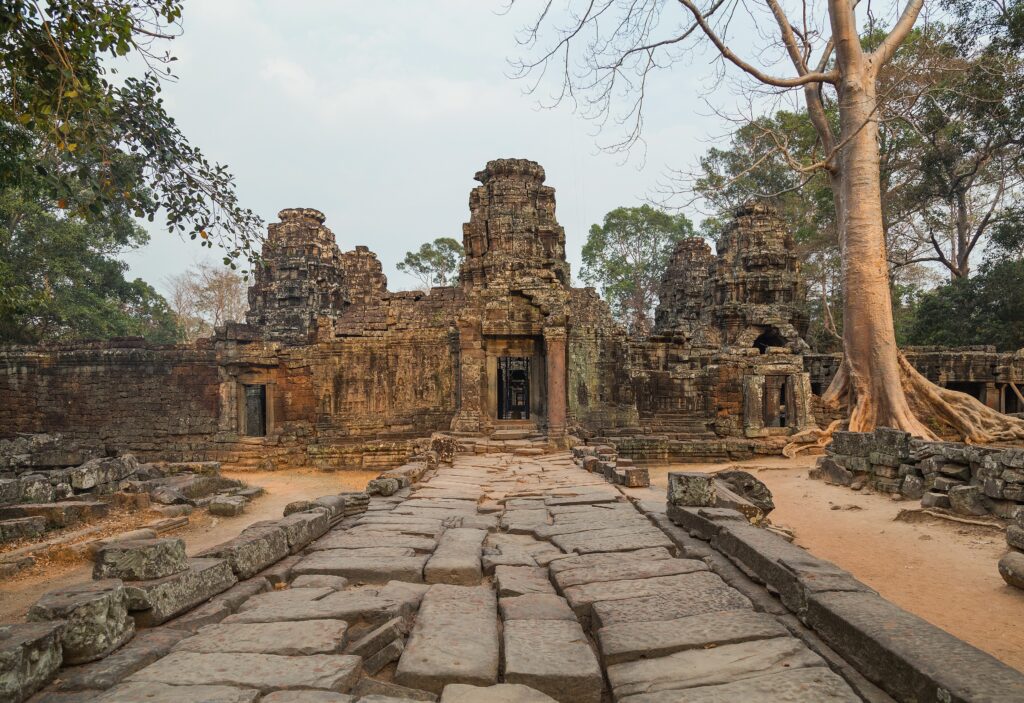
In the outer enclosures, silk-cotton and fig trees grow out of the galleries. One famous tree wraps a wall near the eastern entrance, and several gateways are held together by roots.
Details
Devatas and defaced Buddhas
Graceful female guardians survive in niches along the walls, alongside the outlines of seated Buddhas chiselled away by later kings, a reminder of Angkor’s religious shifts.
Walking through the temple
Preah Khan is laid out along a long east to west axis, with shrines to Shiva to the north and Vishnu to the west, and ancestor shrines to the south. The most rewarding way to see it is to walk the whole axis in one direction and meet your driver at the other end.
0 to 10 minutes Walk the avenue of carved boundary posts from the west gate and cross the causeway with its gods and demons
10 to 30 minutes Pass through the garuda wall and a succession of low doorways towards the central sanctuary
30 to 50 minutes Explore the central stupa and side galleries, looking for devatas and chiselled Buddhas
50 to 70 minutes Continue east through the Hall of Dancers and detour north to the two-storey building
70 to 90 minutes Leave by the east gate towards the old landing stage on the Jayatataka reservoir
Our advice
Arrange a one-way visit. Ask your tuk-tuk driver to drop you at the west entrance and wait at the east, or the reverse. You avoid walking back the same way.
Stand in the central corridor. Look down the long line of doorways, one inside the other. It is one of the great views at Angkor and rarely crowded.
Take your time off the main axis. The side courtyards hide some of the best trees and carvings.
Tickets and opening hours
Ticket
Covered by the Angkor Pass: 1 day $37, 3 days $62, 7 days $72
Where to buy
Angkor ticket office on Road 60, or online through Angkor Enterprise
Children
Under 12 free; bring a passport as proof of age
Opening hours
Daily, reported as 6:00 am to 6:30 pm; confirm locally
Time needed
An hour for the main axis, up to two hours to explore
Access
Mostly level but with uneven stone, high thresholds and low doorways
Best time to visit
Preah Khan is quiet for most of the day, which is its great appeal. Early morning is particularly lovely, when birdsong fills the forest and light slants through the doorways. Late afternoon is also good, and it fits neatly before a sunset at Pre Rup on the grand circuit.
The trees shade much of the temple, which helps in the hot months from March to May. In the green season from June to October the moss is bright and the moat fills, though paths can be muddy. November to February offers the most comfortable walking weather.
Etiquette and tips
Please do
Cover your shoulders and knees, as at every Angkor temple
Watch your head in the low doorways and your feet on the high thresholds
Carry water; there are few stalls once you are inside
Bring insect repellent in the wet season
Please don’t
Climb on collapsed stones or propped walls
Step past barriers; some galleries are unstable
Touch the carvings or lean on the trees
Fly a drone without a permit
How to get there
Preah Khan lies a short drive beyond the North Gate of Angkor Thom, on the grand circuit. From central Siem Reap it takes roughly 25 to 35 minutes by tuk-tuk, depending on your route. It is an easy bike ride from Angkor Thom along shaded roads.
Most visitors see Preah Khan on their second day, combined with Neak Pean, Ta Som, East Mebon and Pre Rup. It also works as an afternoon add-on after a morning at Banteay Srei.
Neak Pean and the grand circuit
East of Preah Khan lies the Jayatataka, a great reservoir 3.5 kilometres long that Jayavarman VII dug beside the temple. At its centre sits Neak Pean, a small shrine on a round island surrounded by four pools, reached by a wooden walkway across the water. It was probably a place of healing, where water flowed through carved spouts into the pools.
From Neak Pean the grand circuit continues to Ta Som, with its face-tower gate strangled by a fig tree, and on to the East Mebon and Pre Rup, a favourite sunset spot.
Visiting with My Travel Factory
We love sending our guests to Preah Khan on a second day at Angkor, when they are ready for something quieter and wilder. Our guides plan a one-way walk through the temple and time it for the gentle morning light. You will find it in our Siem Reap Slow Travel and Hidden Temples Heartland journeys. Send us an enquiry and we will plan your temple days around you.
Questions travellers ask
What is Preah Khan?
Preah Khan is a 12th-century temple complex near Angkor Thom, built by King Jayavarman VII and dedicated in 1191 to his father. It was a temple, Buddhist university and royal city.
What does Preah Khan mean?
Preah Khan means sacred sword. Its original name was Nagara Jayasri, meaning holy city of victory.
Is Preah Khan included in the Angkor Pass?
Yes. Preah Khan is covered by the Angkor Pass, which costs $37 for one day, $62 for three days and $72 for seven days.
How long do you need at Preah Khan?
About an hour to walk the main axis, or up to two hours if you want to explore the side courtyards and the two-storey building.
Is Preah Khan better than Ta Prohm?
It is different. Preah Khan is larger and much quieter, with trees in the stone and a long corridor of doorways. Ta Prohm has the most dramatic trees but many more visitors. If you can, see both.
What is the two-storey building at Preah Khan?
It is a building with round columns and an upper floor, unique at Angkor. Its purpose is not known for certain; one theory is that it housed a sacred relic.
What is the best time to visit Preah Khan?
Early morning or late afternoon for the light and cooler temperatures, although the temple is rarely crowded at any time of day.
How do I get to Preah Khan?
It is just beyond the North Gate of Angkor Thom, about 25 to 35 minutes by tuk-tuk from Siem Reap. Many visitors cycle there from Angkor Thom.
Who looks after Preah Khan?
The World Monuments Fund has worked on its conservation since 1991, alongside the APSARA National Authority, stabilising it as a partial ruin.
What is near Preah Khan?
Neak Pean, a shrine on an island in the Jayatataka reservoir, is just east. The grand circuit continues to Ta Som, the East Mebon and Pre Rup.
Banteay Kdei is a late 12th-century Buddhist monastery temple in the Angkor Archaeological Park, built by King Jayavarman VII in the Bayon style. It lies just…
Where
Small Circuit, Angkor Archaeological Park, just east of Ta Prohm
Cambodia Wildlife Sanctuary is an elephant rescue and forest conservation project about 100 km north of Siem Reap, developed with the Save Elephant Foundation. It protects…
Where
About 100 km north of Siem Reap, on the edge of Kulen Promtep Wildlife Sanctuary