Anyone who loves fine detail more than sheer scale
Temples and ruinsType
In short
Banteay Srei is a small Hindu temple dedicated to Shiva, consecrated in 967 and built by courtiers of King Rajendravarman II rather than by a king. Carved from pink sandstone, it has the finest and deepest decorative carving at Angkor, including the famous pediment of Ravana shaking Mount Kailasa. It lies about 25 km north-east of the main Angkor group, 45 minutes to an hour from Siem Reap, and is covered by the Angkor Pass.
About 25 km north-east of the main Angkor group; 45 to 60 minutes from Siem Reap by car
Built
Consecrated 22 April 967, by the courtiers Yajnavaraha and Vishnukumara
Dedicated to
Shiva (original name Tribhuvanamaheshvara)
Ticket
Covered by the Angkor Pass ($37 for 1 day, $62 for 3 days, $72 for 7 days)
Opening hours
Daily, reported as 6:00 am to 6:30 pm; confirm locally
Time needed
45 minutes to an hour, plus the drive
Best time
Opening time or late afternoon, when low sun lights the carving
Dress code
Shoulders and knees covered
Don't miss
The Ravana shaking Mount Kailasa pediment on the south library
Combine with
Kbal Spean, Banteay Samre and the Cambodia Landmine Museum
Banteay Srei is a small 10th-century Hindu temple dedicated to Shiva, carved from rosy pink sandstone and covered in the finest decoration at Angkor. It lies about 25 kilometres north-east of the main temple group, and for many visitors this jewel box of a temple is the unexpected highlight of their trip.
967Year of consecration
ShivaThe god it honours
9.8 mHeight of the tallest tower
25 kmNorth-east of Angkor Wat’s group
45 to 60 minTime most people spend
Banteay Srei is tiny next to Angkor Wat. The central towers are barely taller than a two-storey house and the doorways are so low that adults have to stoop. That scale is the point. Every surface was carved with the care of a jeweller, and the red stone has held that detail for more than a thousand years.
History of Banteay Srei
22 April 967
The temple is consecrated during the reign of King Rajendravarman II. It is built not by a king but by two courtiers, Yajnavaraha and his brother Vishnukumara. Yajnavaraha was a learned Brahmin and a tutor to the future king Jayavarman V.
10th century
Its original name is Tribhuvanamaheshvara, “great lord of the threefold world”, a name for Shiva. The modern name, Banteay Srei, means “citadel of the women” or “citadel of beauty”, probably for the delicacy of its carving.
Later centuries
The temple remains in use for several hundred years, with additions and changes, before falling out of use and into the forest.
1914
French surveyors rediscover the temple, far from the main Angkor group.
1923
The young French writer André Malraux removes four devata figures and tries to take them out of the country. He is arrested, the carvings are returned, and the scandal makes the temple famous.
1931 to 1936
Henri Marchal of the École française d’Extrême-Orient restores the temple by anastylosis, taking it apart and rebuilding it stone by stone. It is the first time the method is used at Angkor. The foundation stele is found in 1936.
2000 to 2003
A joint Cambodian and Swiss conservation project installs drainage to protect the temple from water damage, and visitor facilities are improved.
Why the carving is so special
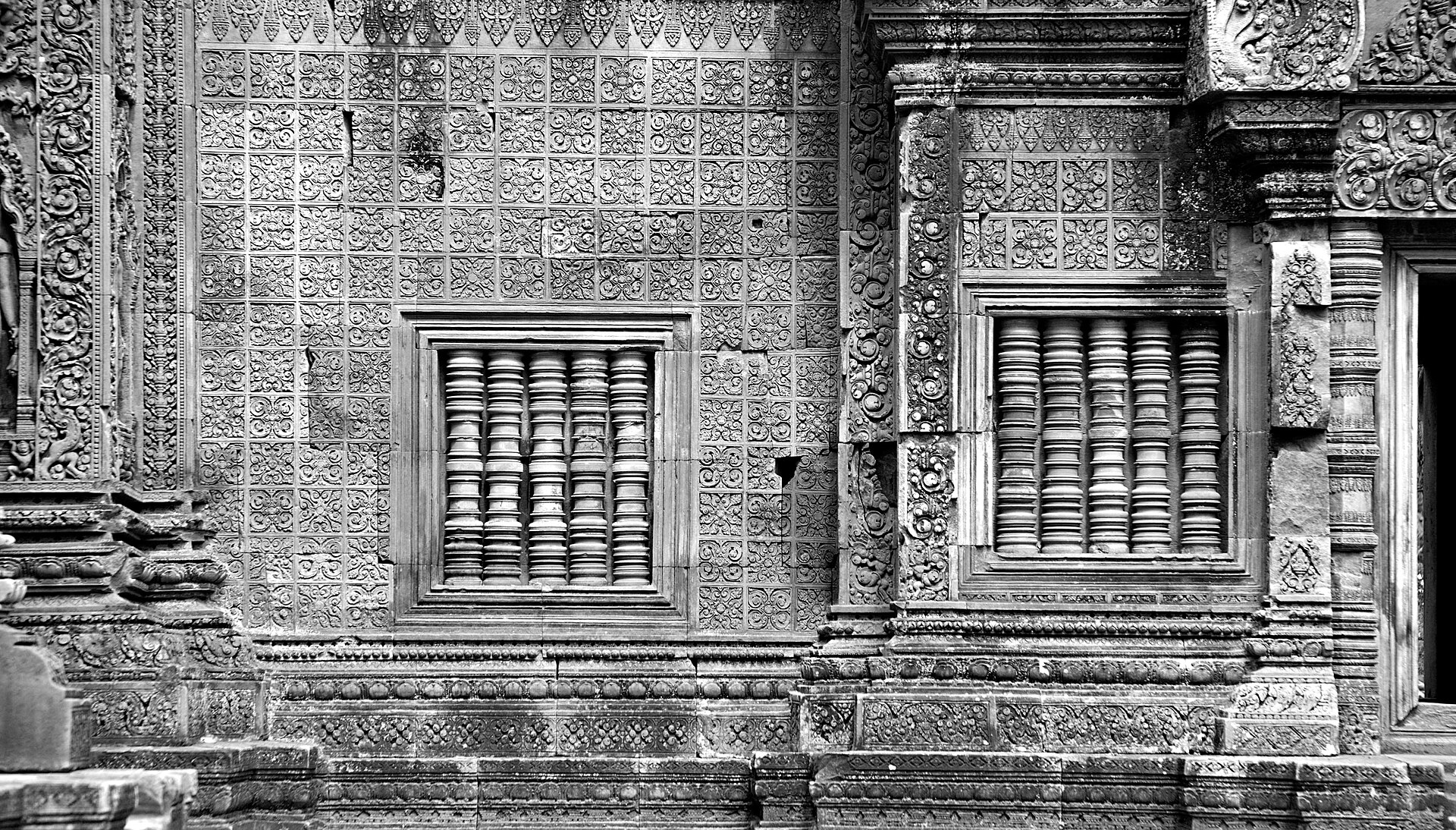
Most Angkor temples are built from grey or greenish sandstone. Banteay Srei uses a hard, fine-grained pink sandstone that could be carved almost like wood. The sculptors took full advantage. Pediments are carved so deeply that figures stand almost free of the background, and foliage curls in layers across lintels, pilasters and false doors.
Unusually for Angkor, the pediments tell complete stories from Hindu mythology in a single frame, with characters, landscape and action. Scholars see Banteay Srei as a turning point in Khmer art, and many of its motifs were copied at later temples. The light changes the colour of the stone through the day, from dusty pink to deep coral.
What to see
South library
Ravana shaking Mount Kailasa
The most famous pediment at Angkor. The many-headed demon king shakes Shiva’s mountain home while animals flee and Shiva and Parvati sit calmly at the top.
North library
The burning of the Khandava forest
Indra sends rain to put out a fire lit by Agni, while Krishna and Arjuna hold it back with a canopy of arrows. Look for the fine diagonal lines of the rain.
Central platform
The animal-headed guardians
Kneeling figures with the heads of monkeys, lions and birds guard the stairs to the three shrines. Most are replicas; the originals were stolen or moved to museums for safekeeping.
Shrine walls
The devatas
Graceful female guardians in niches on the corners of the shrines, with elaborate jewellery and hair. These are the figures Malraux tried to take.
East gopura
Indra on Airavata
The first pediment you meet shows Indra, god of the east, riding his three-headed elephant. It sets the tone for everything inside.
Details
False doors and lintels
Look closely at the false doors of the shrines, carved to imitate panelled wood, and at lintels thick with garlands, monster faces and tiny figures.
The central shrines stand on a raised platform behind a rope, so you view them from a few metres away. The libraries and gateways can be seen up close, which is where the best carving is.
Tickets and opening hours
Ticket
Covered by the Angkor Pass: 1 day $37, 3 days $62, 7 days $72
Pass check
Your pass is checked at the entrance, so buy it before you set off
Children
Under 12 free; bring a passport as proof of age
Opening hours
Daily, reported as 6:00 am to 6:30 pm; confirm locally
Time needed
45 minutes to an hour at the temple, plus the drive
Facilities
Car park, toilets, restaurants and stalls at the entrance, and a small interpretation centre
Our advice
Buy your Angkor Pass first. The main ticket office is on Road 60 at the edge of Siem Reap, so buy your pass there or online before heading out.
Go early or late. Low sun rakes across the carving and brings out the depth. At midday the light is flat and the stone looks pale.
Take a guide. The pediments are stories. A guide who can read them turns a pretty ruin into a picture book.
Best time to visit
Banteay Srei is small, so crowds matter more here than at larger temples. Tour groups tend to arrive from mid-morning until early afternoon. Arrive at opening time or after about 3:30 pm and you will enjoy it in relative calm, with the warm light that makes the stone glow.
For the season, November to February brings the most comfortable temperatures. In the green season from June to October the rice fields along the road are brilliant green and the stone turns a richer red when wet. March to May is very hot; an early start is essential.
Etiquette and tips
Please do
Cover your shoulders and knees
Stay behind the ropes around the central shrines
Bring a zoom lens or use your phone’s zoom for the pediments
Walk the moat path round the back for a quieter view
Please don’t
Touch the carvings; the sandstone is soft and easily worn
Sit or climb on the walls, lintels or guardian figures
Block the narrow gateways for long photo sessions
Fly a drone without a permit
How to get there
Banteay Srei is about 25 kilometres north-east of the main Angkor group, near the village of the same name. From Siem Reap the drive takes 45 minutes to an hour by car and a little longer by tuk-tuk along a paved road through villages and rice fields. It usually forms part of the “grand circuit” day, or a separate half day on its own.
On the way, many visitors stop at Pre Rup or at Banteay Samre, a well-restored 12th-century temple in the Angkor Wat style. The Cambodia Landmine Museum also lies on the road to Banteay Srei and makes a thought-provoking stop.
Combining Banteay Srei with Kbal Spean
Kbal Spean, the “river of a thousand lingas”, is further north in the foothills of the Kulen hills. Carvings of Vishnu, Shiva and hundreds of lingas are cut into the riverbed and banks, reached by a forest walk of about 1.5 kilometres uphill. It pairs perfectly with Banteay Srei:
7:00 am Leave Siem Reap by car
8:00 am Kbal Spean walk and carvings, about two hours
10:30 am Banteay Srei, before the midday heat builds, one hour
Lunch At a local restaurant by Banteay Srei, famed for Khmer curries in coconut
Afternoon Banteay Samre on the way back, or rest and see Preah Khan near sunset
Check whether Kbal Spean needs a separate ticket when you plan; recent reports differ. If you have time for a longer day, Phnom Kulen is also in this direction, with its waterfall and reclining Buddha.
Visiting with My Travel Factory
We schedule Banteay Srei for the soft morning or late afternoon light, with a private driver and a Khmer guide who can read the stories in the stone. It features in our Siem Reap Slow Travel and Cradle of the Khmer journeys, and we can add it to any trip. Explore our heritage experiences or send us an enquiry.
Questions travellers ask
What is Banteay Srei?
Banteay Srei is a 10th-century Hindu temple dedicated to Shiva, about 25 km north-east of the main Angkor group. It is famous for the exceptionally fine carving on its pink sandstone.
What does Banteay Srei mean?
Banteay Srei means citadel of the women, or citadel of beauty. It is a modern name, probably inspired by the delicacy of the carving. The original name was Tribhuvanamaheshvara.
Who built Banteay Srei?
It was built by two courtiers, Yajnavaraha and Vishnukumara, and consecrated on 22 April 967 during the reign of Rajendravarman II. It is the only major Angkor temple not built by a king.
Is Banteay Srei included in the Angkor Pass?
Yes. Banteay Srei is covered by the Angkor Pass. Buy your pass at the main ticket office or online before you go.
How far is Banteay Srei from Siem Reap?
It is about 25 km north-east of the main Angkor group, a drive of 45 minutes to an hour by car from Siem Reap, a little longer by tuk-tuk.
How long do you need at Banteay Srei?
45 minutes to an hour is enough for the temple itself. Allow a half day including the drive, or a full day with Kbal Spean.
Why is Banteay Srei pink?
It is built from a hard, fine-grained pink sandstone. The stone allowed sculptors to carve extraordinary detail and changes colour with the light.
What is the best time to visit Banteay Srei?
Early morning at opening time or late afternoon. The low sun brings out the depth of the carving and the crowds are thinner.
Is Banteay Srei worth the drive?
Yes, if you enjoy art and detail. It is small, but many visitors rate its carving as the finest they see in Cambodia.
What happened with André Malraux at Banteay Srei?
In 1923 the French writer André Malraux removed four carved devatas and tried to smuggle them out. He was arrested and the carvings were returned.
Banteay Kdei is a late 12th-century Buddhist monastery temple in the Angkor Archaeological Park, built by King Jayavarman VII in the Bayon style. It lies just…
Where
Small Circuit, Angkor Archaeological Park, just east of Ta Prohm
Cambodia Wildlife Sanctuary is an elephant rescue and forest conservation project about 100 km north of Siem Reap, developed with the Save Elephant Foundation. It protects…
Where
About 100 km north of Siem Reap, on the edge of Kulen Promtep Wildlife Sanctuary