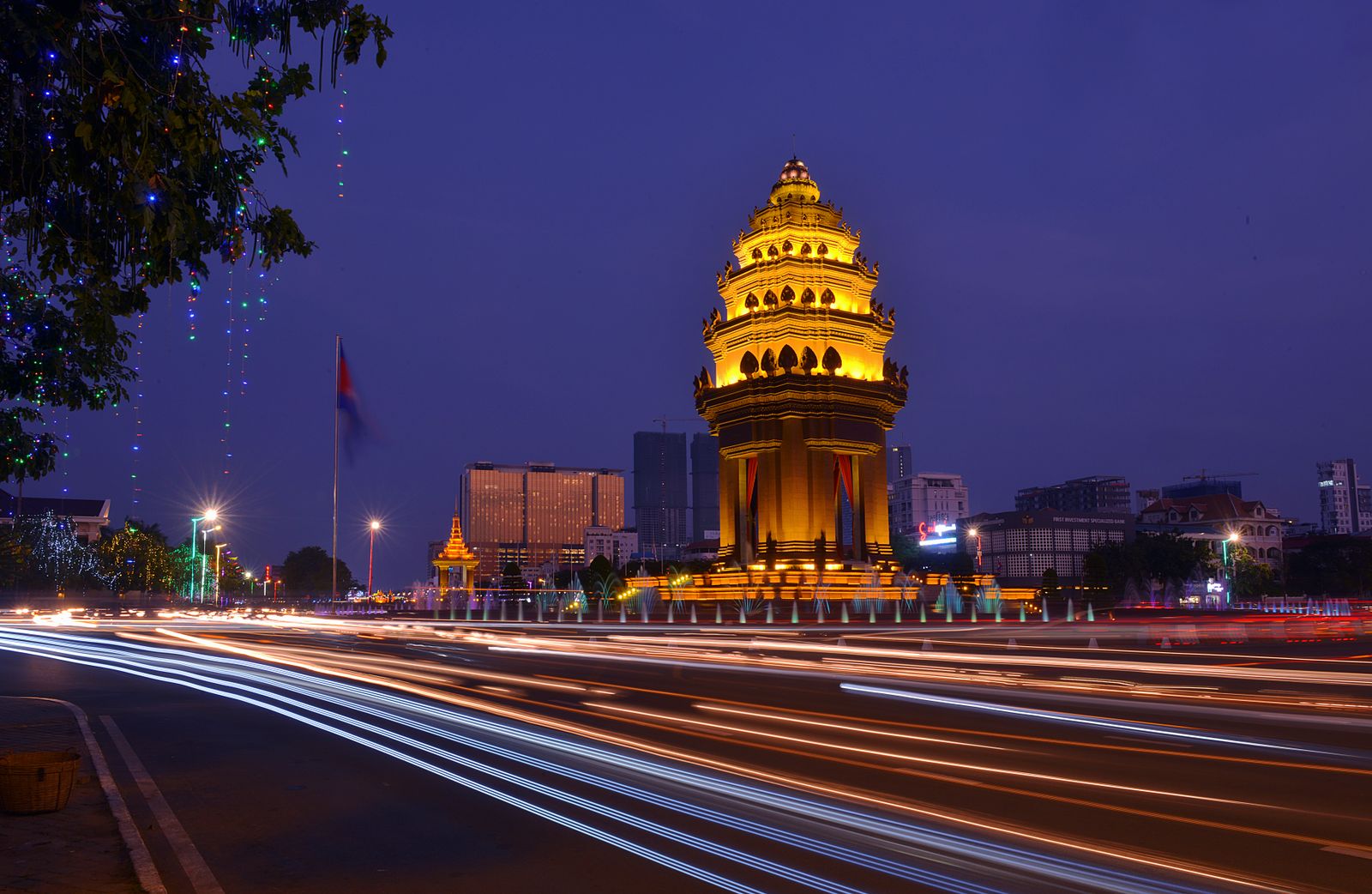
The Independence Monument in Phnom Penh at night
Read the country through its buildings

Architectural tours of Cambodia

Angkorian hydraulics, the French shophouse street and the concrete modernism of the Sangkum years - with people who can actually read a plan.

In short

Cambodia has three distinct architectural periods worth travelling for: the Angkorian temples and the hydraulic landscape they sit inside, the French colonial shophouse towns of Phnom Penh, Battambang and Kampot, and New Khmer Architecture - the modernist programme led by Vann Molyvann between independence in 1953 and 1970. Our architectural tours run as half or full days in one city, or as a route linking all three periods.

Checked

September 2026

Three periods

What you are actually looking at

9th - 15th century

Angkorian

The Khmer Empire built in sandstone and laterite at a scale nothing else in the region matched, and the interesting part is not the carving - it is the water. Angkor was an engineered hydraulic landscape of barays, moats and channels, and the temples sit inside that system rather than beside it.

  • Angkor Wat - the plan, the galleries and the bas-relief sequence
  • The Bayon - face towers and the shift from Hindu to Buddhist patronage
  • Ta Prohm - what the trees are actually doing to the stone
  • Banteay Srei - pink sandstone and the finest carving in the country
  • The West Baray - the reservoir that explains the rest of it
1863 - 1953

French colonial

Ninety years of protectorate left Phnom Penh, Battambang and Kampot with shophouse terraces, administrative blocks and villas built for a climate the builders were still learning. The best of it is not the grand civic work but the ordinary street: deep shade, louvred shutters and ventilation designed before air conditioning existed.

  • Phnom Penh Central Market - Art Deco, 1937, and still the coolest room in the city
  • The Post Office quarter and the streets of Daun Penh
  • Battambang’s shophouse riverfront - the most intact colonial townscape in Cambodia
  • Kampot’s old town and the road up to Bokor
  • The Royal Railway station, Phnom Penh
1953 - 1970

New Khmer Architecture

The Sangkum years produced one of the twentieth century’s great national modernisms, led by Vann Molyvann: concrete, cross-ventilation, water and raised floors, borrowing directly from Angkorian planning and from the stilted Khmer house. Much of it has been lost to development, which is exactly why it is worth seeing now.

  • Independence Monument, 1958 - Vann Molyvann
  • Chaktomuk Conference Hall - the fan plan on the riverfront
  • The National Sports Complex - a stadium built as a hydraulic landscape
  • The Institute of Foreign Languages, Royal University of Phnom Penh
  • The White Building site - and the argument about what replaced it

Questions people ask

Do I need to be an architect to enjoy this?
No. The guides pitch to the group, and the modernist tour in particular works as social history - why a newly independent country built the way it did, and what happened to those buildings afterwards. We do also run a technical version for visiting practices and student groups.
Can we go inside the buildings?
Some, sometimes. Several New Khmer Architecture buildings are working institutions, so access depends on the day and on permission we request in advance. We tell you what is confirmed and what is hoped for before you book, rather than after you arrive.
How is this different from a normal Angkor tour?
A normal temple tour tells you the stories in the carvings. This one explains the plan, the structure, the water system and the construction sequence - why the galleries are where they are, how the corbelled vaults work, and what the barays were for.
Is it walkable, or do we drive?
The Phnom Penh colonial route is walkable in a morning. The modernist buildings are spread across the city, so that one is by car or, better in our view, by bicycle - the distances suit it and you see the streets between the buildings, which is half the subject.
Formats

Four ways to take it

  1. 01

    Modernist Phnom Penh

    Half a day across the city's Vann Molyvann buildings, by car or bicycle.

  2. 02

    The colonial street

    A walking morning through Daun Penh, or a day in Battambang, which is more intact.

  3. 03

    Angkor as engineering

    A full day at the temples reading structure, plan and hydraulics rather than legend.

  4. 04

    The three-period route

    Six to eight days linking Siem Reap, Battambang and Phnom Penh in chronological order.

Next

Goes well with this

Plan a trip