First-time visitors, and anyone who came to Cambodia for one thing
Temples and ruinsType
In short
Angkor Wat is the largest religious monument in the world, built between 1113 and about 1150 by King Suryavarman II as a Hindu temple to Vishnu and later used as a Buddhist temple. It lies about 6 km north of Siem Reap, covers 162.6 hectares inside a 190 metre wide moat and is famous for its bas-relief galleries and sunrise views. It opens daily from 5:00 am to 6:00 pm, and entry needs an Angkor Pass: $37 for one day, $62 for three days or $72 for seven days.
Angkor Archaeological Park, about 6 km north of Siem Reap
Built
1113 to about 1150, under King Suryavarman II
Religion
Built for Vishnu (Hindu); Buddhist since the late 13th century
Ticket
Angkor Pass: 1 day $37, 3 days $62, 7 days $72
Opening hours
Daily, 5:00 am to 6:00 pm
Bakan (upper level)
About 7:30 am to 5:00 pm; closed on Buddhist holy days; no children under 12
Time needed
Three to four hours; three days for the wider park
Best time
Sunrise, or mid-afternoon for light on the western facade
Dress code
Shoulders and knees covered, enforced for the upper level
UNESCO
Part of the Angkor World Heritage Site since 1992
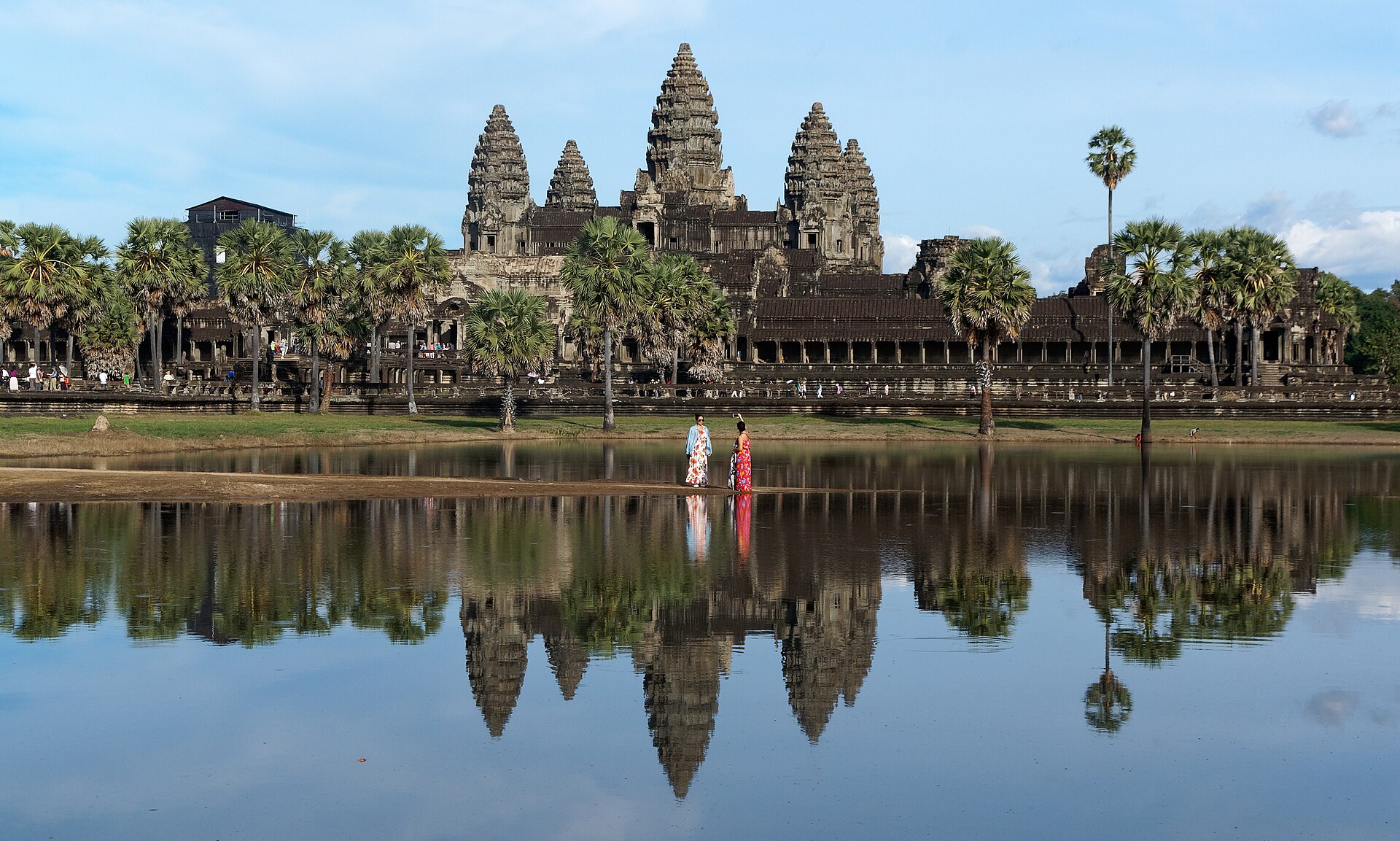
Angkor Wat is the largest religious monument in the world, a 12th-century Hindu temple built by King Suryavarman II and dedicated to Vishnu, later a Buddhist sanctuary that has never been entirely abandoned. It stands about 6 kilometres north of Siem Reap, and its five lotus-bud towers, rising above a vast moat, are the symbol of Cambodia and the centrepiece of any visit to Angkor.
1113 to 1150Built under Suryavarman II
162.6 haArea of the site
65 mHeight of the central tower
190 mWidth of the moat
1992UNESCO World Heritage (Angkor)
Photographs prepare you for the towers, but not for the scale. The outer wall alone runs for more than a kilometre on its longer sides, the causeway feels like a road, and the carved galleries could keep you busy for a day. Give it time, and ideally a good guide.
History of Angkor Wat
1113 to about 1150
King Suryavarman II builds Angkor Wat as his state temple and probable mausoleum, dedicated to the Hindu god Vishnu. Construction takes around three decades and ends soon after his death.
1177
A Cham army sacks Angkor. Jayavarman VII later drives them out and builds his new capital, Angkor Thom, just to the north.
Late 13th century onwards
Angkor Wat gradually becomes a Theravada Buddhist temple. Buddha images are placed in its galleries and the central shrine, and monks have lived here ever since.
1586
The Portuguese friar António da Madalena visits and describes it as a building unlike any other in the world.
1860
The French naturalist Henri Mouhot writes about Angkor Wat, and his account makes it famous in Europe.
1863
Angkor Wat first appears on the Cambodian flag. It has featured on every national flag since, in one form or another.
1986 to 1992
The Archaeological Survey of India restores parts of the temple. International teams, including the German Apsara Conservation Project for the carvings, continue the work today.
1992
Angkor, including Angkor Wat, is inscribed on the UNESCO World Heritage List.
A temple built as a universe
Angkor Wat is a model of the Hindu universe in stone. The central tower is Mount Meru, home of the gods, and the four corner towers are its surrounding peaks. The galleries are mountain ranges and the moat is the ocean around the world.
Unusually, the temple faces west, where most Khmer temples face east. West is associated with Vishnu and with death, which supports the idea that it was also Suryavarman II’s funerary temple. It is also why the classic view from the causeway is best at sunrise, with the towers silhouetted against the eastern sky. At the spring equinox the sun rises almost directly over the central tower when seen from the western entrance.
What to see
The approach
The western causeway
A long stone causeway crosses the moat to the western entrance, lined with naga balustrades. It is the first great view of the towers and still thrills after many visits.
First level
The bas-relief gallery
Covered galleries on all four sides carved with epics, battles and the king’s own procession. One of the greatest works of relief carving anywhere.
Everywhere
The devatas
More than 1,700 carved female figures stand on the walls, each with her own hairstyle, jewellery and expression. Look for the rare one showing her teeth in a smile.
Second level
The cruciform cloister
Four sunken courtyards once filled with water, where you still find Buddha images left by pilgrims over the centuries, and a hall known as the Gallery of a Thousand Buddhas.
The summit
The Bakan
The steep upper level around the central tower, reached by a single wooden staircase. The views across the galleries and forest are superb. Access is limited; see the table below.
Living temple
Monks and worshippers
Angkor Wat is still a place of worship. You will see monks in saffron robes, offerings and incense, and families praying at the Buddha images.
The great bas-relief gallery
The outer gallery of the first level is lined on all four sides with continuous carved panels, among the finest reliefs in Southeast Asia. Read them anticlockwise, starting from the western entrance and turning right, as they were meant to be seen.
The Battle of Kurukshetra (west gallery, south side): the climactic battle of the Mahabharata, with armies clashing in dense, detailed ranks.
The procession of Suryavarman II (south gallery, west side): the king holds court and his army marches, the only historical scene in the gallery.
Heaven and Hell (south gallery, east side): the judgement of souls, with the blessed above and the torments of the damned below.
The Churning of the Ocean of Milk (east gallery, south side): gods and demons pull on a serpent to churn the ocean, with Vishnu at the centre. The most famous panel at Angkor.
The Battle of Lanka (west gallery, north side): from the Ramayana, with Rama and the monkey army fighting the demon king Ravana.
The remaining panels show Vishnu and Krishna defeating demons, and a great battle between gods and demons. Some sections were completed later, in the 16th century, and are noticeably different in style.
Sunrise at Angkor Wat
Sunrise over Angkor Wat is one of the great travel experiences, and it is popular for good reason. Most people gather at the pond on the left, or north, side of the path inside the western entrance, where the towers reflect in the water.
Our advice
Arrive early. The temple opens at 5:00 am. The sky starts colouring about 30 to 40 minutes before the sun appears, and the best spots by the pond fill quickly in high season.
Buy your pass the day before. A pass bought after about 4:45 pm lets you in that evening for sunset without using a day, and saves queueing before dawn.
Don’t leave straight after sunrise. Most people head off for breakfast. Walk into the temple instead and enjoy the galleries while they are quiet.
Try the east side. The rear, eastern entrance is far quieter and makes a lovely route in or out.
Tickets and opening hours
Angkor Pass
1 day $37; 3 days $62 (use within 7 days); 7 days $72 (use within 30 days)
Where to buy
Angkor ticket office on Road 60, about 4 km from central Siem Reap, or online through Angkor Enterprise
Ticket office hours
Early morning to 5:30 pm; confirm opening time locally
Children
Under 12 free; bring a passport as proof of age
Angkor Wat hours
Daily, 5:00 am to 6:00 pm
Bakan (upper level)
From about 7:30 am to about 5:00 pm; closed on Buddhist holy days; not open to children under 12
Time needed
Three to four hours for the temple; half a day with sunrise
Your photo is printed on the pass, so it cannot be shared. Keep it with you all day, as it is checked at Angkor Wat and at most other temples.
Dress code and etiquette
Please do
Cover your shoulders and knees; this is enforced at the Bakan
Take off your hat at shrines and near monks
Ask before photographing monks or worshippers
Carry water and sun protection; the causeway and courtyards are exposed
Please don’t
Touch or lean on the bas-reliefs; they are polished smooth where hands have rubbed
Climb on walls, statues or closed staircases
Fly a drone without a permit
Pose in a way that disrespects the Buddha images
How to plan your visit
One day at Angkor is enough for Angkor Wat, the Bayon and Ta Prohm. Three days is the honest answer if you want to enjoy the wider park without rushing. A good first morning looks like this:
4:45 am Leave Siem Reap by tuk-tuk or car
5:15 am Take your place by the north pond for sunrise
6:30 am Walk into the temple while the crowds go for breakfast
7:00 am The bas-relief gallery, starting at the west side and turning right
8:30 am The cruciform cloister, then the Bakan when it opens
9:30 am Leave by the east gate and continue to Angkor Thom, or return for breakfast and a rest
If sunrise is not for you, visit in the afternoon instead, when the western facade glows in the sun and the light suits photography. The temple is also quieter at lunchtime, though it is hot.
How to get there
Angkor Wat is about 6 kilometres north of central Siem Reap, roughly 15 to 20 minutes by tuk-tuk. The ticket office on Road 60 is on the way. Tuk-tuks, private cars with drivers, bicycles and electric bikes are all easy to arrange in town. For sunrise, agree the pick-up time with your driver the evening before.
Before or after your visit, the Angkor National Museum in Siem Reap gives useful background on the temples and the Khmer Empire.
Visiting with My Travel Factory
We plan Angkor Wat around the light and the crowds, with a private driver, your own Khmer guide and time to linger in the galleries after sunrise. It is at the heart of our Cambodia Classic Highlights and Phnom Penh & Angkor Discovery journeys, and we can build it into any trip. Browse our heritage experiences or send us an enquiry.
Questions travellers ask
What is Angkor Wat?
Angkor Wat is a 12th-century temple complex near Siem Reap, built by King Suryavarman II as a Hindu temple to Vishnu and later used as a Buddhist temple. It is the largest religious monument in the world.
How much is the Angkor Wat ticket?
Entry needs an Angkor Pass: $37 for one day, $62 for three days (use within 7 days) or $72 for seven days (use within 30 days). Children under 12 enter free.
What time does Angkor Wat open?
Angkor Wat opens daily from 5:00 am to 6:00 pm. The upper level, the Bakan, opens from about 7:30 am to about 5:00 pm.
What time should I arrive for sunrise at Angkor Wat?
Aim to arrive soon after the 5:00 am opening. The sky starts colouring 30 to 40 minutes before the sun rises, and the best spots by the north pond fill quickly in high season.
Where do I buy Angkor Wat tickets?
At the official ticket office on Road 60, about 4 km from central Siem Reap, or online through Angkor Enterprise. There is no ticket sale at the temple itself.
How long do you need at Angkor Wat?
Three to four hours for the temple itself, or half a day including sunrise. Three days are ideal for the wider Angkor park.
What is the dress code for Angkor Wat?
Cover your shoulders and knees. The rule is enforced at the upper level, the Bakan, and it is respectful throughout.
Why does Angkor Wat face west?
West is associated with Vishnu and with death, so the orientation supports the idea that it was built as Suryavarman II's funerary temple as well as a place of worship.
Can children climb to the top of Angkor Wat?
No. Children under 12 are not allowed on the Bakan, the upper level. The rest of the temple is open to them.
Is Angkor Wat still a religious site?
Yes. It has been a Buddhist temple for centuries, and monks and local worshippers still come to pray and make offerings.
Do I need a guide at Angkor Wat?
Not to enter, but a good guide transforms the visit, especially the bas-relief gallery, which tells stories that are hard to read on your own.
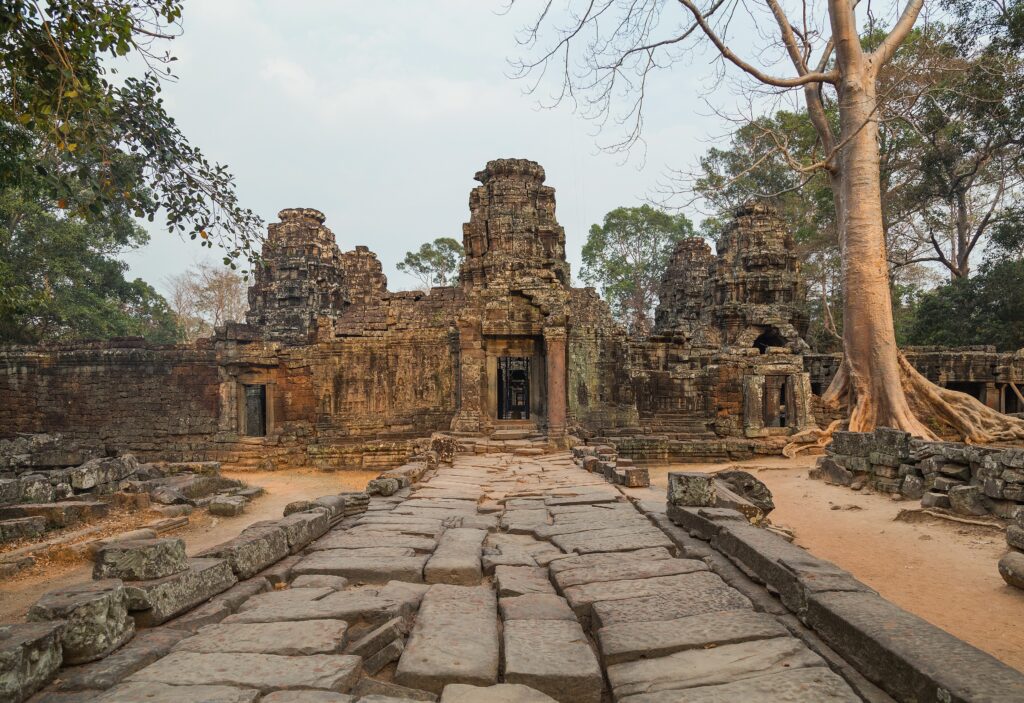
Banteay Kdei is a late 12th-century Buddhist monastery temple in the Angkor Archaeological Park, built by King Jayavarman VII in the Bayon style. It lies just…
Where
Small Circuit, Angkor Archaeological Park, just east of Ta Prohm
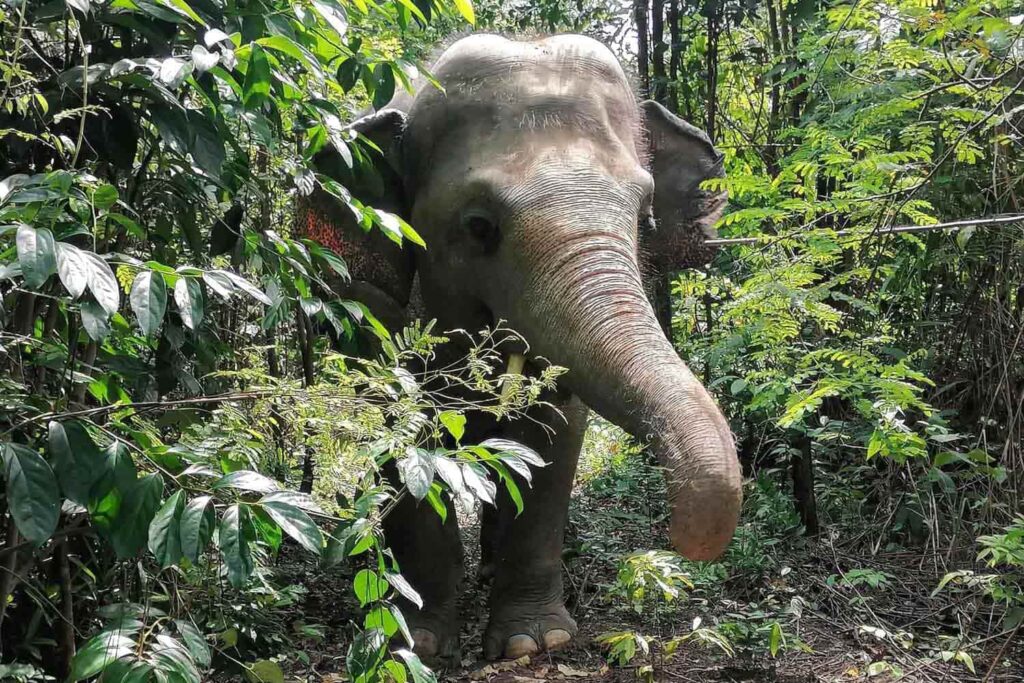
Cambodia Wildlife Sanctuary is an elephant rescue and forest conservation project about 100 km north of Siem Reap, developed with the Save Elephant Foundation. It protects…
Where
About 100 km north of Siem Reap, on the edge of Kulen Promtep Wildlife Sanctuary