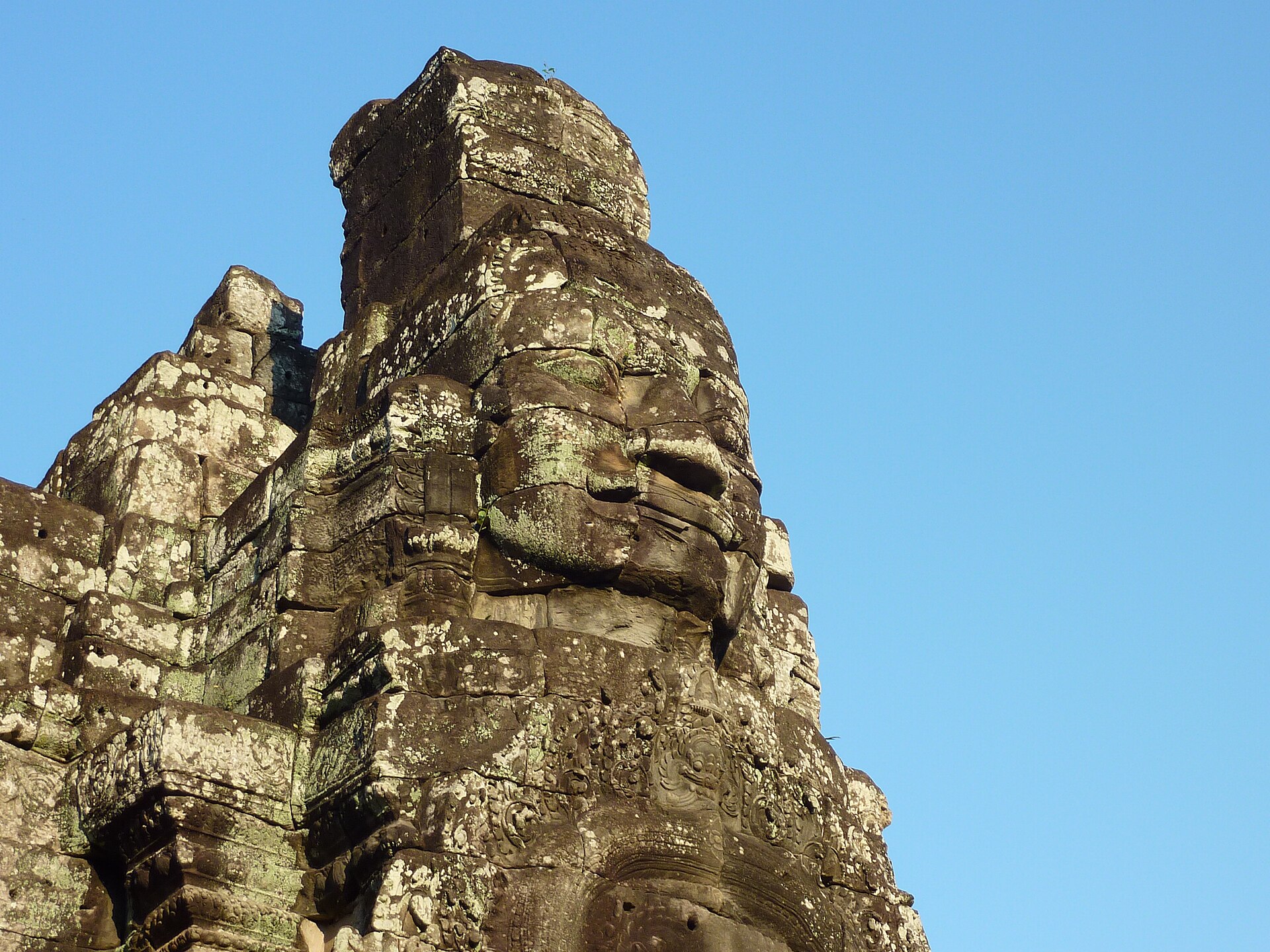
The famous faces, and the most human carvings at Angkor
Temples and ruinsType
In short
The Bayon is the state temple of King Jayavarman VII at the centre of Angkor Thom, built in the late 12th and early 13th century as a Mahayana Buddhist temple. It is famous for about 200 serene stone faces carved on its 37 surviving towers and for outer gallery reliefs showing everyday Khmer life and a naval battle against the Cham. Entry is covered by the Angkor Pass, and 60 to 90 minutes is enough for most visitors.
Centre of Angkor Thom, Angkor Archaeological Park, Siem Reap
Built
Late 12th to early 13th century, under King Jayavarman VII
Religion
Mahayana Buddhist, later partly reworked for Hindu worship
Ticket
Covered by the Angkor Pass ($37 for 1 day, $62 for 3 days, $72 for 7 days)
Opening hours
Daily, reported as 6:00 am to 6:30 pm; confirm locally
Time needed
60 to 90 minutes, or up to two hours with the reliefs
Best time
Straight after sunrise, before the tour groups, or late afternoon
Dress code
Shoulders and knees covered
Don't miss
The outer gallery reliefs of daily life and the Tonle Sap naval battle
Distance
About 1.5 km north of the South Gate; 20 to 30 minutes by tuk-tuk from Siem Reap
The Bayon is the temple of faces at the heart of Angkor Thom, the walled royal city built by King Jayavarman VII. Around 200 huge, calm stone faces look out from its towers in every direction, and its outer galleries hold the liveliest carvings at Angkor. If Angkor Wat is the masterpiece, the Bayon is the one that stays in your head.
Late 12th centuryBuilt under Jayavarman VII
About 200Carved stone faces
37Towers still standing
43 mHeight of the central tower
1992UNESCO World Heritage (Angkor)
The Bayon stands at the exact centre of Angkor Thom, where the roads from the city’s four cardinal gates meet. From the ground it looks like a heap of grey rock. Climb to the upper terrace and the heap resolves into a crowd of towers, and the towers into faces.
History of the Bayon
1181
Jayavarman VII takes the throne after driving the Cham out of Angkor. He becomes the greatest builder in Khmer history and a devout Mahayana Buddhist.
Late 12th to early 13th century
The Bayon rises as the state temple of his new capital, Angkor Thom. It is the last great state temple built at Angkor. The plan changes several times during construction, which is partly why it feels so crowded.
Mid-13th century
Jayavarman VIII restores Hindu worship. Buddhist images are defaced, chapels are removed and Hindu scenes are added to the inner galleries. A 3.6 metre seated Buddha from the central sanctuary is smashed and thrown into a pit.
15th century onwards
The royal court moves south and the forest slowly covers the city, though the temple is never entirely forgotten by local people.
1933
French archaeologists of the École française d’Extrême-Orient recover the broken Buddha from the pit beneath the central tower and restore it.
1995 to today
The Japanese Government Team for Safeguarding Angkor (JSA), working with the APSARA National Authority, leads conservation of the Bayon. You will often see scaffolding on one side of the temple.
Whose faces are they?
Nobody knows for certain, and that is part of the pleasure. Each tower carries two, three or four faces, looking outward to the points of the compass. Scholars have proposed three main answers.
Avalokiteshvara, the bodhisattva of compassion, watching over the kingdom in every direction
Jayavarman VII himself, portrayed as a divine king merged with the bodhisattva
Brahma or protective deities of the cardinal points, an older Hindu reading
Most guides today lean towards a mix of the first two. Look at the faces for long enough and you will notice they are not identical: the lips, eyelids and headdresses vary from tower to tower. The famous half-smile is sometimes called the “smile of Angkor”.
What to see
The Bayon has three levels. The first two are galleries of carved reliefs; the third is the upper terrace, where the face towers crowd around the round central sanctuary.
Upper terrace
The face towers
The reason everyone comes. Walk slowly around the terrace and the faces appear and disappear between the towers. Several can be seen at eye level, close enough to study every line.
Outer gallery
Life in the 12th century
Long walls of reliefs showing Khmer armies on the march, a naval battle against the Cham, markets, cooking, fishing and cockfights. The best social history in stone at Angkor.
Inner gallery
The Hindu reworking
Smaller, finer panels of Shiva, Vishnu and scenes of palace life, many added when the temple was turned back to Hindu worship after Jayavarman VII’s death.
Central sanctuary
The heart of the temple
A dark, round chamber that once held the great seated Buddha. Today there is usually a small shrine with incense, tended by local worshippers.
Throughout
Apsaras and devatas
Dancing apsaras carved on pillars and doorways, often in groups of three on lotus flowers. They are smaller and livelier than the stately devatas of Angkor Wat.
Outside
The eastern approach
The main entrance faces east. Start here for the best first view of the towers and to follow the reliefs in the order they were meant to be read.
Reading the outer gallery reliefs
The outer gallery is where the Bayon beats every other temple at Angkor. The lower registers of the long walls show ordinary life around the great events: women buying fish, a man roasting a pig, a birth, a board game, Chinese merchants in their distinctive dress and acrobats entertaining a crowd.
The south wall is the one to find. It shows the naval battle on the Tonle Sap lake in which the Khmer fought the Cham, with boats full of warriors, crocodiles snapping at the fallen and fishermen carrying on below. The east wall shows the Khmer army on the march, with elephants, carts and cooks.
Our advice
Walk the outer gallery first. Most visitors head straight up to the faces and never see the reliefs. Start at the east entrance and walk clockwise along the south side.
Look low. The small scenes of daily life are in the bottom band of carving, below the armies.
Take a guide for the reliefs. A good Khmer guide will point out the market scenes, the Chinese traders and the story of the battle in minutes.
Tickets and opening hours
Ticket
Covered by the Angkor Pass: 1 day $37, 3 days $62 (use within 7 days), 7 days $72 (use within 30 days)
Where to buy
Angkor ticket office on Road 60, or online through Angkor Enterprise
Children
Under 12 free; bring a passport as proof of age
Opening hours
Daily, reported as 6:00 am to 6:30 pm for the main temples; confirm locally
Time needed
60 to 90 minutes, or two hours if you want the reliefs properly
Accessibility
Steep, uneven steps to the upper terrace; the outer gallery is mostly level
Carry your Angkor Pass at all times. Staff check it at the entrance to the Bayon and at many other temples, and a pass bought for the following day lets you in from late afternoon the evening before.
Best time to visit
The Bayon faces east, so the morning sun falls on the front of the towers. The classic plan is to come straight here after sunrise at Angkor Wat, or to skip the sunrise and arrive when the temple opens. Tour groups usually reach the Bayon from about 9:00 am, and the upper terrace stays busy until early afternoon.
Late afternoon is the other good window. The crowds thin out, the stone warms to gold and the faces take on long shadows. For the season, November to February is the coolest and driest. The green season from June to October brings fewer visitors, lush forest and dramatic skies, with showers usually in the afternoon.
Etiquette and tips
Please do
Cover your shoulders and knees; the Bayon is still a place of worship
Wear shoes with good grip for the steep steps
Leave a small offering or a dollar at an active shrine if you light incense
Bring water and a hat; there is little shade on the upper terrace
Please don’t
Climb on the towers, walls or fallen stones
Touch or lean on the carvings; skin oils damage the sandstone
Pose for photos in front of monks without asking
Fly a drone without a permit from the APSARA National Authority
The nose-to-nose photo. On the upper terrace there is one spot where you can line up your face with a stone face. Everyone does it. Be patient, take your turn and step aside for the next person.
How to get there
The Bayon is inside Angkor Thom, about 1.5 kilometres north of the South Gate. From central Siem Reap it is roughly 20 to 30 minutes by tuk-tuk, passing Angkor Wat on the way. Most visitors enter through the South Gate, which is worth a stop in its own right.
Cycling is a lovely way to reach it. The roads inside the park are flat and shaded, and a bicycle lets you stop wherever you like between the South Gate, the Bayon and the terraces. Electric bikes are widely available for hire in Siem Reap.
Nearby in Angkor Thom
The Bayon is the centre of a half-day visit to the walled city. A relaxed route looks like this:
7:30 am Stop at the South Gate causeway with its rows of gods and demons
8:00 am The Bayon: outer gallery reliefs first, then the upper terrace, 90 minutes
9:30 am Walk north to the Baphuon, a huge temple mountain with a reclining Buddha on its western side
10:30 am The Terrace of the Elephants and the Terrace of the Leper King
Late morning Continue by tuk-tuk to Ta Prohm, before lunch in Siem Reap
Add Preah Khan on a second day if you want another of Jayavarman VII’s great temples without the crowds.
Visiting with My Travel Factory
We plan our Angkor days around the light and the crowds, so you reach the Bayon when it is quiet and your Khmer guide can read the reliefs with you rather than over the heads of a tour group. The Bayon is part of our Cambodia Classic Highlights and our unhurried Siem Reap Slow Travel journey. Tell us how you like to travel and we will shape the temple days around you. See more of our heritage experiences.
Questions travellers ask
What is the Bayon temple?
The Bayon is the state temple of King Jayavarman VII, built in the late 12th and early 13th century at the centre of his capital, Angkor Thom. It is a Buddhist temple famous for the giant stone faces carved on its towers.
How many faces are there at the Bayon?
There are about 200 faces on the 37 towers that still stand. Some towers have collapsed, so the original number was higher.
Who do the Bayon faces represent?
No one knows for certain. The most common theories are the bodhisattva Avalokiteshvara, King Jayavarman VII himself, or a blend of the two.
Is the Bayon part of Angkor Wat?
No. The Bayon is a separate temple inside Angkor Thom, a few kilometres north of Angkor Wat. Both are covered by the same Angkor Pass.
Do I need a separate ticket for the Bayon?
No. The Bayon is covered by the Angkor Pass, which costs $37 for one day, $62 for three days and $72 for seven days.
What time does the Bayon open?
The main Angkor temples, including the Bayon, are reported to open daily from 6:00 am to 6:30 pm. Hours can change, so confirm locally.
How long do you need at the Bayon?
Allow 60 to 90 minutes for the face towers and a look at the reliefs, or about two hours if you want to walk the whole outer gallery.
What is the best time to visit the Bayon?
Early morning, straight after sunrise at Angkor Wat or at opening time, before tour groups arrive around 9:00 am. Late afternoon is quieter too.
Is the Bayon difficult to climb?
The steps to the upper terrace are steep and uneven but short. The outer gallery is mostly level. Wear shoes with good grip.
What is the dress code at the Bayon?
Cover your shoulders and knees. The Bayon is still an active place of worship, with small shrines tended by local people.
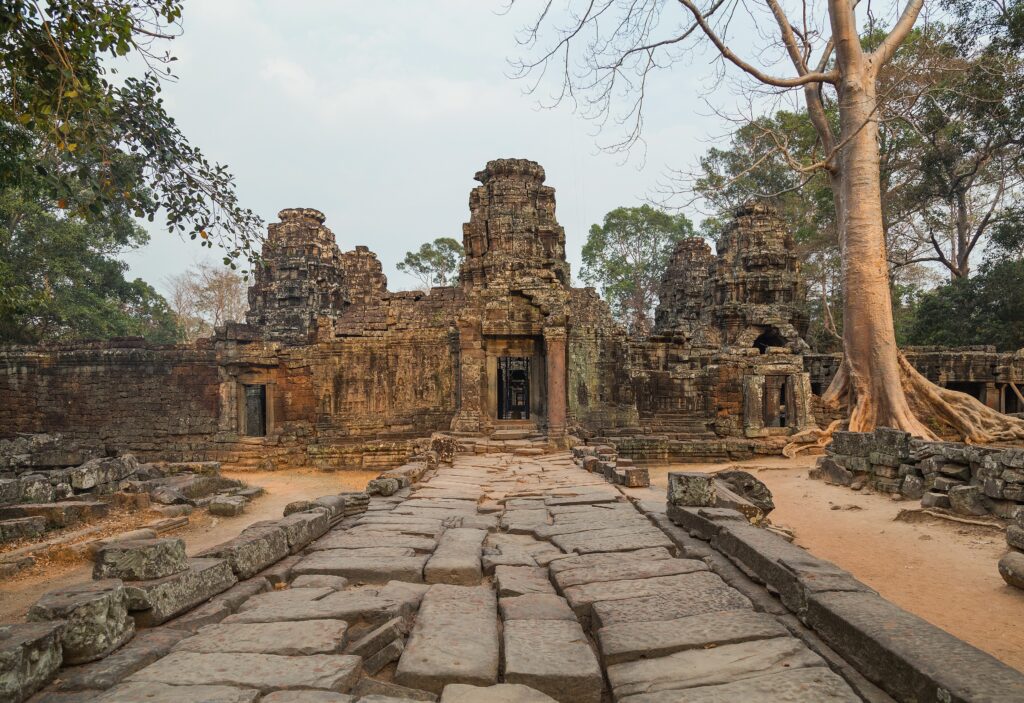
Banteay Kdei is a late 12th-century Buddhist monastery temple in the Angkor Archaeological Park, built by King Jayavarman VII in the Bayon style. It lies just…
Where
Small Circuit, Angkor Archaeological Park, just east of Ta Prohm
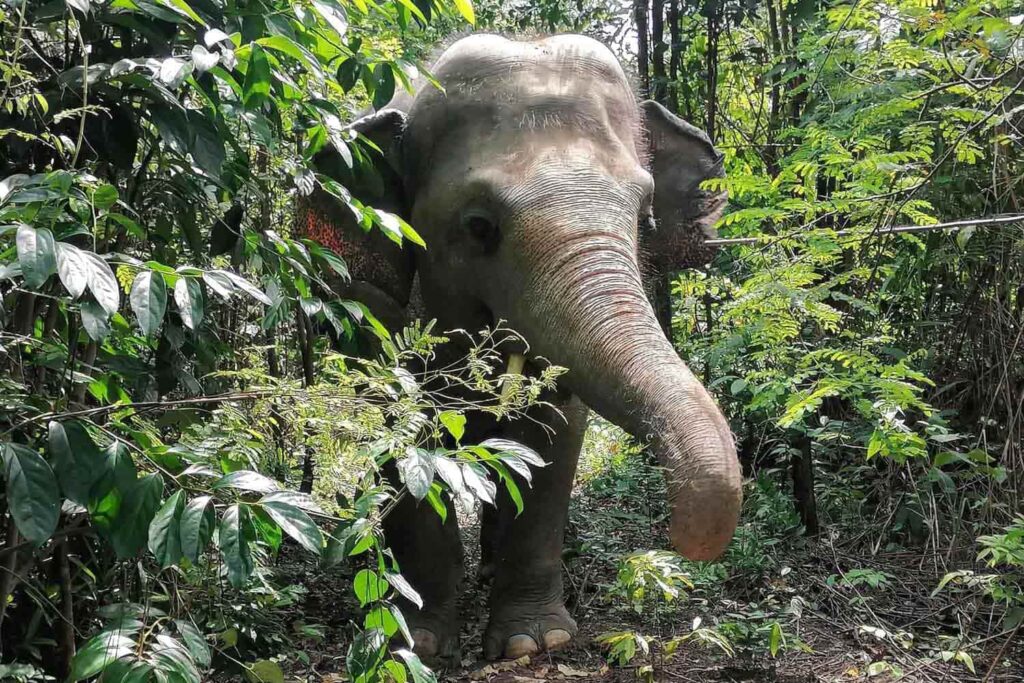
Cambodia Wildlife Sanctuary is an elephant rescue and forest conservation project about 100 km north of Siem Reap, developed with the Save Elephant Foundation. It protects…
Where
About 100 km north of Siem Reap, on the edge of Kulen Promtep Wildlife Sanctuary