Wat Phnom is a Buddhist temple on a 27-metre artificial hill in central Phnom Penh, and the place from which the city takes its name. Legend says a widow called Daun Penh founded it in 1372 to house Buddha statues she found in the river; King Ponhea Yat later rebuilt it and his ashes lie in its great stupa. It is open daily from 7 am to 6 pm, and foreign visitors pay $1.
Norodom Boulevard and Street 96, northern central Phnom Penh
Height
27 metres, the only hill in the city centre
Founded
Legend dates it to 1372, by Daun Penh
Present vihara
Rebuilt in 1926
Royal stupa
Holds the ashes of King Ponhea Yat
Opening hours
Daily, 7:00 am to 6:00 pm
Tickets
$1 for foreign visitors; free for Cambodians
Time needed
45 minutes to an hour
Dress code
Shoulders and knees covered; shoes off in the vihara
Watch out for
The monkeys, who steal food and bags
Wat Phnom is the hilltop temple that gave Phnom Penh its name: the “hill of Penh”, after the woman whose discovery of sacred statues in the river led to its founding. It stands 27 metres high in a shady park at the northern end of the city centre, and it is still one of the busiest places of worship in the capital.
1372Year of the founding legend
27 mHeight of the hill
1926Present vihara rebuilt
$1Foreign visitor ticket
45 to 60 minTime to allow
Don’t expect a grand monument. Wat Phnom is small and you can see it all in under an hour. What makes it special is the atmosphere: families bringing offerings, students praying before exams, fortune tellers under the trees and the smell of incense drifting down the stairs.
The legend of Lady Penh
According to the story every Cambodian knows, a wealthy widow named Daun Penh, Grandmother Penh, lived by the river in 1372. After a flood she saw a large koki tree floating in the water. When it was pulled ashore she found four bronze Buddha statues inside, along with a stone figure of the Hindu god Vishnu.
Daun Penh saw this as a sign from heaven. She had her neighbours raise an artificial hill and built a small shrine on top to house the statues. The settlement that grew up around it became known as Phnom Daun Penh, the hill of Grandmother Penh, which in time became Phnom Penh.
Why the story matters
For Cambodians, Wat Phnom is where the capital began. Many residents climb the hill to ask Daun Penh and the guardian spirits for help with health, business, exams or a new baby, and return with offerings of jasmine, bananas or incense when their wish comes true.
History of Wat Phnom
1372 to 1373
Following the legend, Daun Penh raises the hill and builds the first shrine for the statues found in the river.
1434
King Ponhea Yat moves the Khmer capital from the Angkor region to Phnom Penh. The temple on the hill is rebuilt and enlarged.
15th century
After Ponhea Yat’s death, his ashes are placed in the great stupa on the summit, which still dominates the hill.
1806 and 1894
The vihara, the main sanctuary, is rebuilt twice more.
1926
The present vihara is built, with the murals and gilded Buddha you see today.
Today
The park around the hill is restored and landscaped, and the temple remains an active place of worship and the focus of city celebrations at Khmer New Year.
What to see
A path winds around the hill, so you can climb the grand staircase on the east side and make a loop back down through the trees.
The approach
The naga staircase
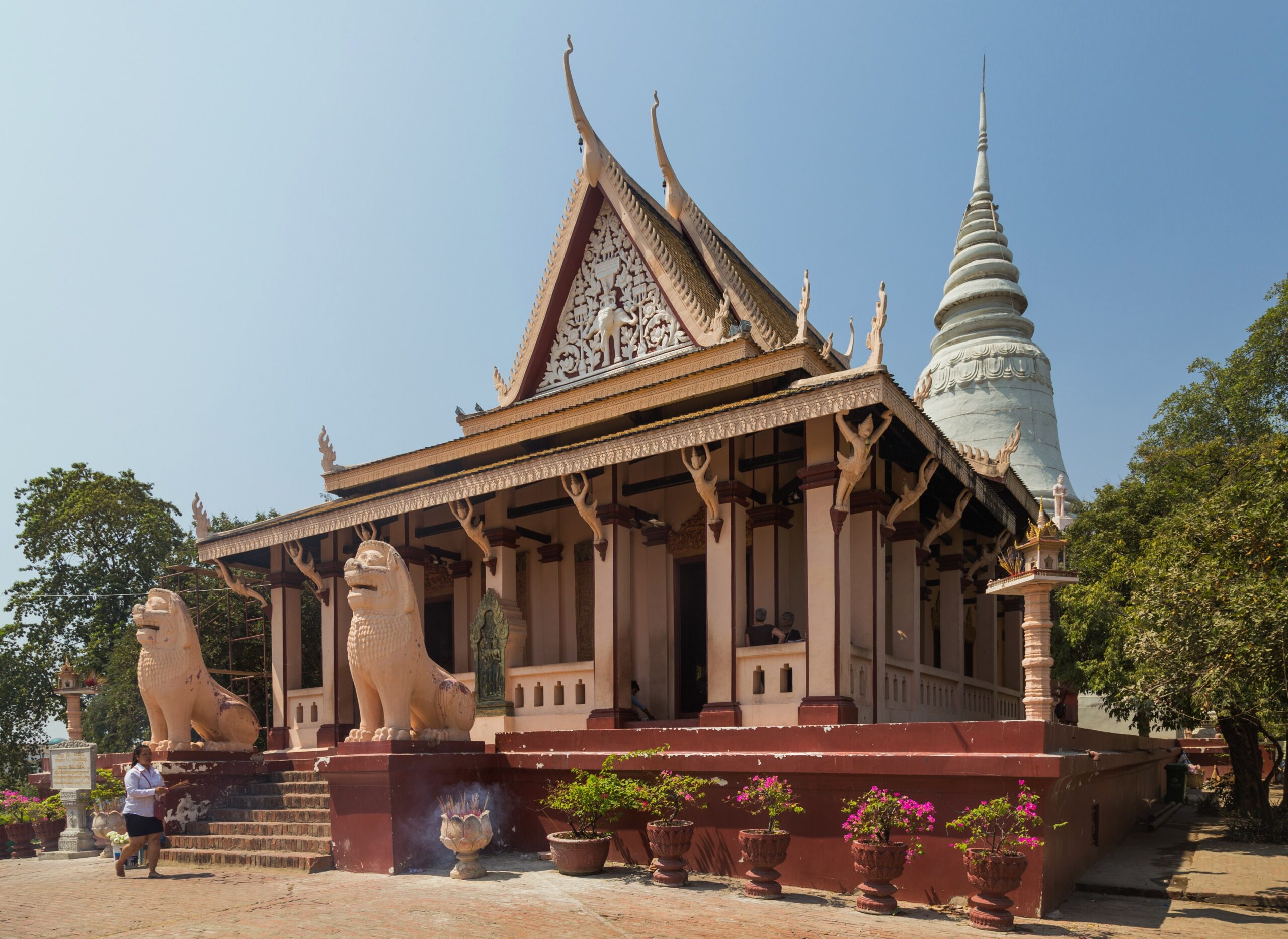
The main stairs on the east side are guarded by stone lions and flanked by balustrades shaped like seven-headed naga serpents. It is the classic photograph of Wat Phnom.
The summit
The vihara
The sanctuary at the top, rebuilt in 1926. Inside is a large bronze Buddha surrounded by smaller images, with walls painted with scenes from the Buddha’s life and the Reamker.
Royal
The stupa of Ponhea Yat
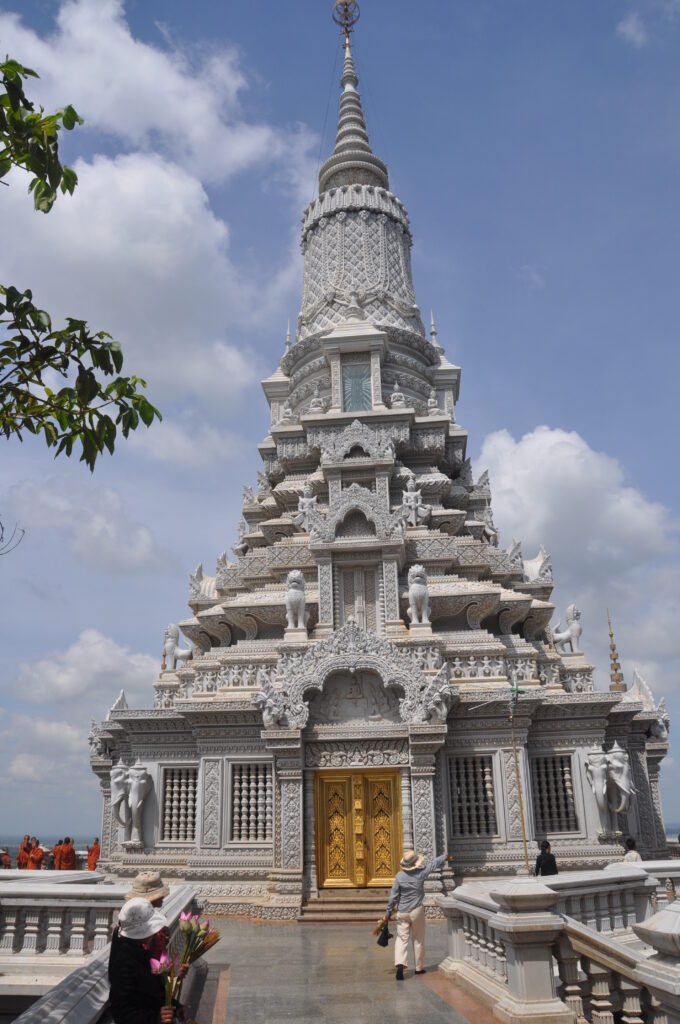
The large white stupa behind the vihara holds the ashes of King Ponhea Yat, who made Phnom Penh his capital in the 15th century.
Most visited
The shrine of Daun Penh
A small pavilion on the south side of the summit with a statue of Grandmother Penh. For locals it is the heart of the visit, always busy with offerings.
Spirit shrine
Preah Chau and the Vishnu statue
A shrine to the genie Preah Chau, protected by fierce guardian figures, and an eight-armed Vishnu. Hindu and Buddhist worship sit side by side here, as they have in Cambodia for centuries.
The park
The floral clock
A large working clock laid out in flowers on the south slope, a favourite spot for local photos, especially on weekends and holidays.
The hill is also home to a troop of macaques. They are entertaining to watch and very good at stealing food, water bottles and unattended bags.
Take time for the park at the foot of the hill as well. In the late afternoon it fills with vendors selling jasmine garlands, lotus buds and grilled snacks, fortune tellers set up small tables in the shade, and families settle on mats on the grass. It is one of the best places in the capital to watch ordinary Phnom Penh life.
Opening hours and tickets
Opening hours
Every day, 7:00 am to 6:00 pm
Foreign visitors
$1, paid at the kiosk at the foot of the stairs
Cambodian nationals
Free
Time needed
45 minutes to an hour
Payment
Cash, US dollars or riel
Busiest days
Weekends, Buddhist holy days and Khmer New Year in mid-April
The ticket price has stayed at $1 for many years, but confirm at the kiosk. The park around the hill is open to everyone and free to walk in.
Etiquette and tips
Please do
Cover your shoulders and knees
Take off your shoes and hat before entering the vihara
Walk clockwise around the stupa, as local worshippers do
Ask before photographing people at prayer
Please don’t
Feed or tease the monkeys
Carry food or drink openly on the hill
Point your feet towards the Buddha images
Pay for birds to be released; many are recaptured and sold again
Our advice
Go early or late. The hill is shaded, but the stairs are still warm work at midday. Late afternoon, when office workers stop by to pray, is the most atmospheric time.
Combine it with a walk. Wat Phnom is a short stop, best as part of a morning or afternoon exploring the old French quarter.
Keep your bag zipped. The monkeys are bold, and so are the occasional pickpockets in crowds.
Visit at Khmer New Year. In mid-April the park fills with families, music and games. It is crowded but joyful.
How to get there and what is nearby
Wat Phnom stands in the middle of a large roundabout where Norodom Boulevard meets Street 96, at the northern end of the city centre. It is about 10 minutes’ walk from the northern riverside and a short tuk-tuk ride from most central hotels. PassApp and Grab both work well.
The streets around the hill are the heart of the colonial quarter. The old French post office, the National Library and the Raffles Hotel Le Royal are all within a few minutes’ walk. A good half-day route looks like this:
3:30 pm Wat Phnom, about an hour
4:30 pm Walk or tuk-tuk 10 minutes south to the Central Market, before it winds down
5:30 pm Sunset on the riverside, with the Royal Palace lit up at the southern end
Our Phnom Penh city days pair Wat Phnom with the palace, the markets and the riverside, with a local guide who can tell you the stories behind each shrine. It is part of our Phnom Penh & Angkor Discovery and Cambodia Classic Highlights journeys, or explore more of our heritage experiences. Send us an enquiry and we will build the right itinerary for you.
Questions travellers ask
How much is the entrance fee to Wat Phnom?
Foreign visitors pay $1 at the kiosk at the foot of the stairs. Cambodians enter free, and the surrounding park is free for everyone.
What are Wat Phnom's opening hours?
It is open every day from 7:00 am to 6:00 pm.
How did Phnom Penh get its name?
From Wat Phnom. Phnom means hill, and Penh was the widow Daun Penh who, according to legend, built the hill and shrine in 1372 to house Buddha statues found in the river.
Is Wat Phnom worth visiting?
Yes, as a short stop. It is small, but it is the founding place of the city and one of its most active temples, full of local life.
How long do you need at Wat Phnom?
About 45 minutes to an hour is enough to climb the hill, see the vihara and stupa, and walk back down through the park.
Who is buried in the stupa at Wat Phnom?
The large white stupa holds the ashes of King Ponhea Yat, who moved the Khmer capital from the Angkor region to Phnom Penh in the 15th century.
Is there a dress code at Wat Phnom?
It is an active temple, so cover your shoulders and knees and take off your shoes before entering the vihara.
Are there monkeys at Wat Phnom?
Yes. A troop of macaques lives on the hill. Don't feed them and keep food, drinks and bags out of reach.
How high is Wat Phnom?
The hill is 27 metres high. It is man-made, and it is the only hill in the centre of Phnom Penh.
What is near Wat Phnom?
The Central Market is about 10 minutes away, the northern riverside is a short walk east, and the colonial post office and Raffles Hotel Le Royal are close by.
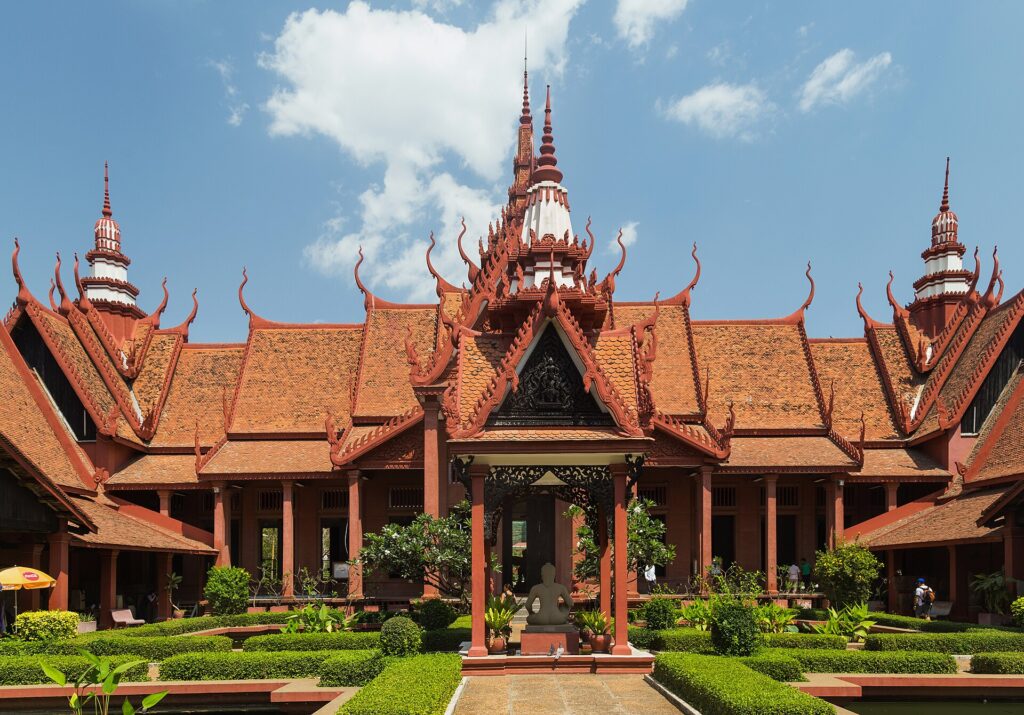
The National Museum of Cambodia in Phnom Penh holds the world's largest collection of Khmer art, more than 14,000 objects from prehistory to the post-Angkor period.…
Where
Corner of Street 13 and Street 178, beside the Royal Palace, Phnom Penh
Opened
13 April 1920, designed by George Groslier
Read more
Free, no-obligation enquiry
Tell us about your trip
Enquiry received
Thank you — a local specialist will be in touch within 24 hours.