History lovers and a half-day escape from Phnom Penh
Temples and ruinsType
In short
Phnom Oudong (Udong) is a hill about 40 km north-west of Phnom Penh that was Cambodia's royal capital until 1866. Its summit holds royal stupas with the ashes of Khmer kings, a white stupa enshrining a relic of the Buddha, and the ruins of Vihear Preah Ath Roes, reached by a staircase of more than 500 steps. Entry is free.
Former royal capital and sacred hill with royal stupas
Where
Oudong, Kandal province, about 40 km from Phnom Penh
Royal capital
From the early 1600s until 1866
Highlights
Buddha relic stupa, royal stupas, Vihear Preah Ath Roes
Climb
500+ steps on the main staircase
Entry
Free; donations welcome
Opening hours
Reported around 7:00 am to 5:30 pm; confirm locally
Time needed
2 to 3 hours on site
Getting there
1 to 1.5 hours by car or tuk-tuk on National Road 5
Best time
Early morning, November to March
Phnom Oudong, often spelled Udong, is a long wooded ridge about 40 km north-west of Phnom Penh that served as Cambodia’s royal capital for more than two centuries, until King Norodom moved the court to Phnom Penh in 1866. Today its summit is crowned by gleaming royal stupas holding the ashes of Khmer kings, a modern stupa enshrining a relic of the Buddha, and sweeping views over rice fields and sugar palms. It is one of the most rewarding day trips from the capital.
About 40 kmNorth-west of Phnom Penh
Until 1866Royal capital of Cambodia
500+ stepsTo the summit stupas
FreeEntry; donations welcome
Half a dayFrom Phnom Penh
A short history of Oudong
After the Thai sack of the earlier capital at Longvek, the Khmer court moved to Oudong in the early 17th century. The name means “the victorious”, and for over 200 years kings were crowned, ruled and cremated here. In 1866 King Norodom, under growing French influence, moved the capital to Phnom Penh, but Oudong remained a sacred royal site, and the ashes of several kings were enshrined on its hilltop.
The mountain suffered badly in the 1970s. Heavy fighting took place here during the civil war, and the Khmer Rouge damaged many of its shrines. The great Vihear Preah Ath Roes and its giant Buddha were blown up in 1977. Much has since been restored, and in 2002 a relic of the Buddha was moved here from Phnom Penh to a new stupa on the ridge.
Early 1600s The royal court moves to Oudong after the fall of Longvek.
1845 to 1860 Reign of King Ang Duong, whose stupa stands on the summit.
1866 King Norodom moves the capital to Phnom Penh.
1977 The Khmer Rouge destroy Vihear Preah Ath Roes and its great Buddha.
2002 A relic of the Buddha is enshrined in a new stupa on the mountain.
What to see on the mountain
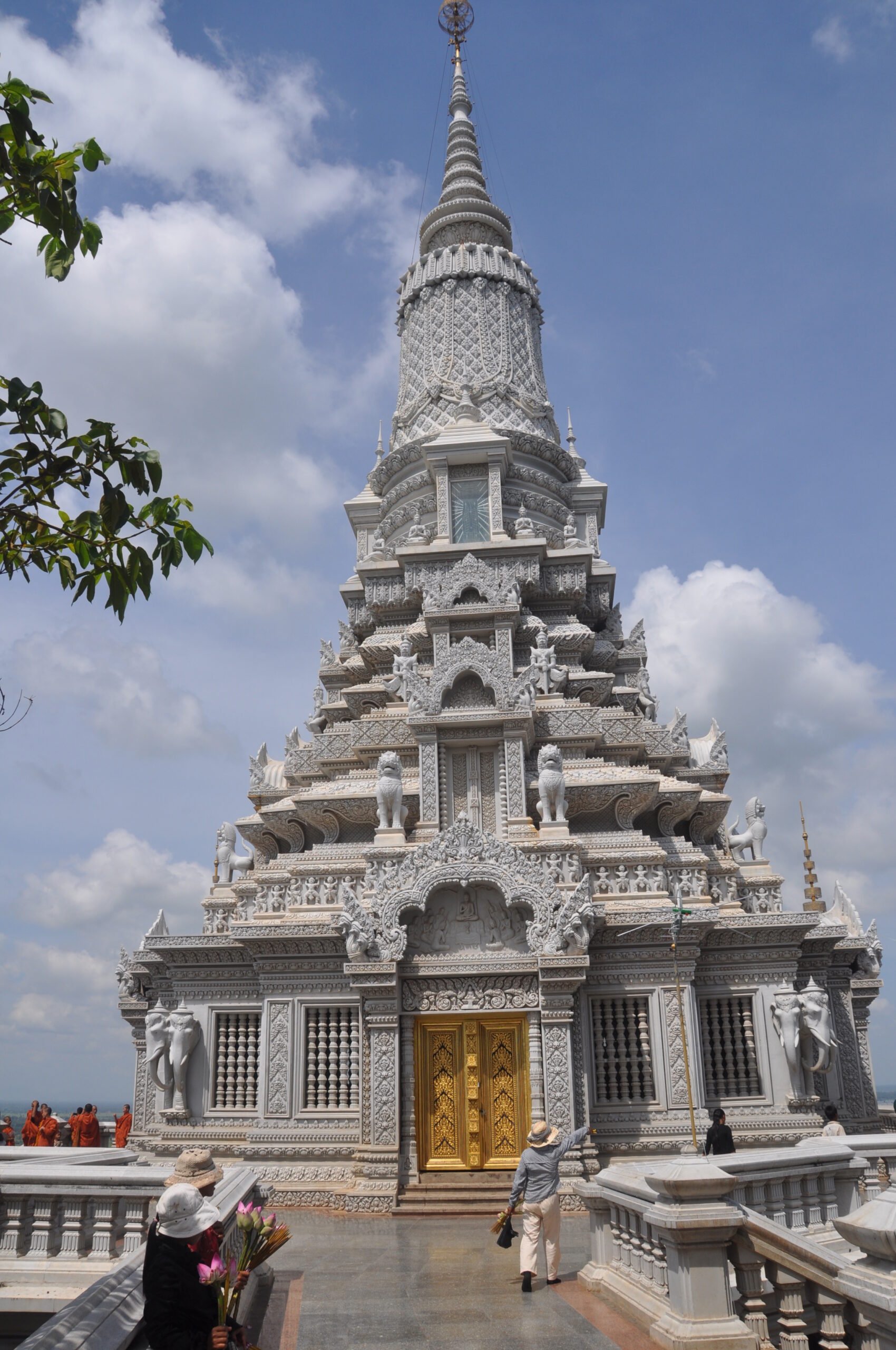
The relic stupa
Preah Sakyamuni Chedi
The gleaming white stupa built in 2002 to house a relic of the Buddha, surrounded by many Buddha images. The most visited shrine on the mountain.
Royal stupa
Damrei Sam Poan
The stupa associated with the king who founded the capital at Oudong, one of the oldest monuments on the ridge.
Royal stupa
Ang Duong stupa
An elaborate stupa for King Ang Duong, one of Cambodia’s most respected 19th-century kings and father of King Norodom.
Royal stupa
Mak Proum
The stupa of King Sisowath Monivong, decorated with faces looking out in four directions, in the style of the towers of the Bayon.
Ruins
Vihear Preah Ath Roes
The “temple of the 18-cubit Buddha”, destroyed in 1977. The damaged Buddha and walls have been partly rebuilt, a moving reminder of the country’s recent past.
Views
The summit panorama
From the ridge, the plains stretch in every direction: rice fields, sugar palms, villages and, on clear days, the Tonle Sap river.
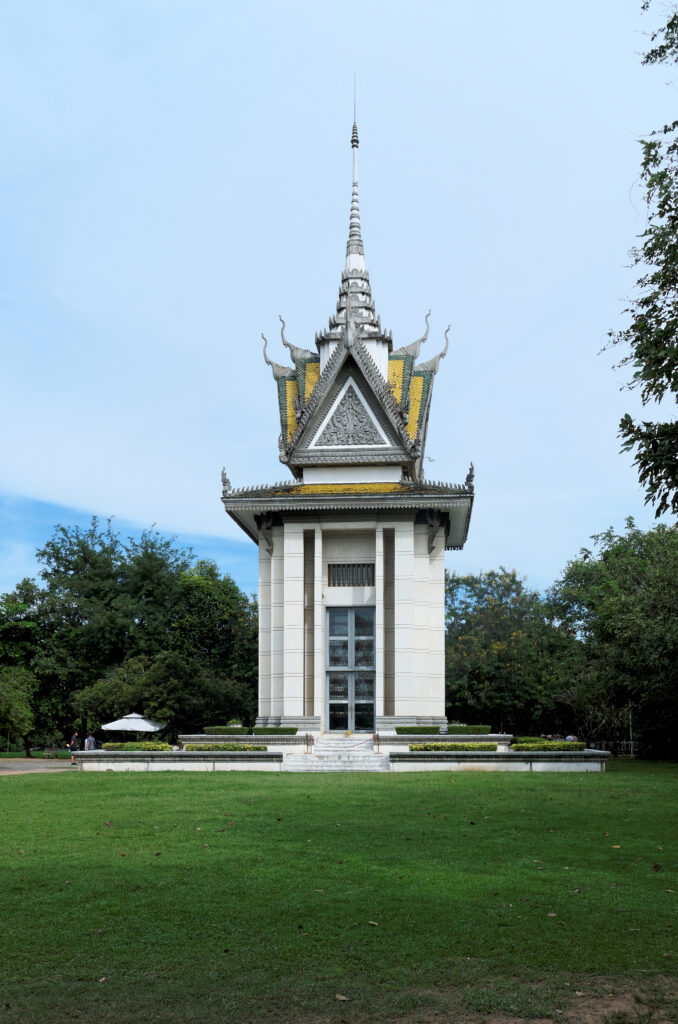
At the foot of the hill, a small memorial holds remains from the Khmer Rouge era. Please visit it quietly and respectfully.
A walking route to the summit
There are several staircases, and the main one, lined with naga balustrades, has more than 500 steps. The climb is steady rather than hard; allow 20 to 30 minutes with stops. A good loop is:
Start Climb the main naga staircase from the car park in the cool of the early morning.
The relic stupa Visit Preah Sakyamuni Chedi at the top of the steps.
Along the ridge Walk past the royal stupas of Ang Duong, Mak Proum and Damrei Sam Poan.
The ruins Continue to the remains of Vihear Preah Ath Roes.
Descend Return by the eastern steps and relax in a hammock hut at the foot of the hill with a cold drink or lunch.
Opening hours and practical information
Opening hours
Reported as daily, around 7:00 am to 5:30 pm; confirm locally
Entry
Free; donations at the shrines are welcome. A small parking fee may apply
Location
Oudong, Kandal province, about 40 km north-west of Phnom Penh off National Road 5
Time needed
2 to 3 hours on site; half a day from Phnom Penh
Climb
500+ steps on the main staircase; a road also runs part of the way up
Food
Stalls and hammock huts with simple Khmer food at the foot of the hill
Best time
Early morning or late afternoon; November to March is the most comfortable season
How to get there
Oudong is an easy half-day trip from Phnom Penh by private car or tuk-tuk, taking about an hour to an hour and a half each way along National Road 5, depending on traffic. Agree the price and waiting time with your driver before you leave. It combines well with a visit to Silk Island (Koh Dach) on the way back, or a stop at a riverside village along the Tonle Sap.
We plan Oudong as a relaxed half day from Phnom Penh with a private driver and a guide who brings the royal stories to life. It fits easily into our Phnom Penh and Angkor discovery journey or any stay in the capital.
Questions travellers ask
What is Oudong?
Oudong, or Udong, is a sacred hill north-west of Phnom Penh that served as Cambodia's royal capital for more than 200 years until 1866. Its summit holds royal stupas and a stupa enshrining a relic of the Buddha.
How far is Oudong from Phnom Penh?
About 40 km, or roughly 1 to 1.5 hours by car or tuk-tuk along National Road 5.
Is there an entrance fee at Oudong?
No. Entry to the mountain is free, though donations at the shrines are welcome and a small parking fee may apply.
How many steps are there at Oudong?
The main naga staircase has more than 500 steps. The climb takes 20 to 30 minutes at an easy pace.
Which kings are enshrined at Oudong?
The summit stupas are associated with several kings, including King Ang Duong and King Sisowath Monivong, whose Mak Proum stupa is decorated with faces in the Bayon style.
What happened to Vihear Preah Ath Roes?
The temple and its giant Buddha were blown up by the Khmer Rouge in 1977. They have since been partly rebuilt.
When was the Buddha relic brought to Oudong?
In 2002 a relic of the Buddha was moved from Phnom Penh to a new stupa on the mountain, Preah Sakyamuni Chedi.
Can I visit Oudong as a day trip?
Yes. It is an easy half-day trip from Phnom Penh and combines well with Silk Island (Koh Dach).
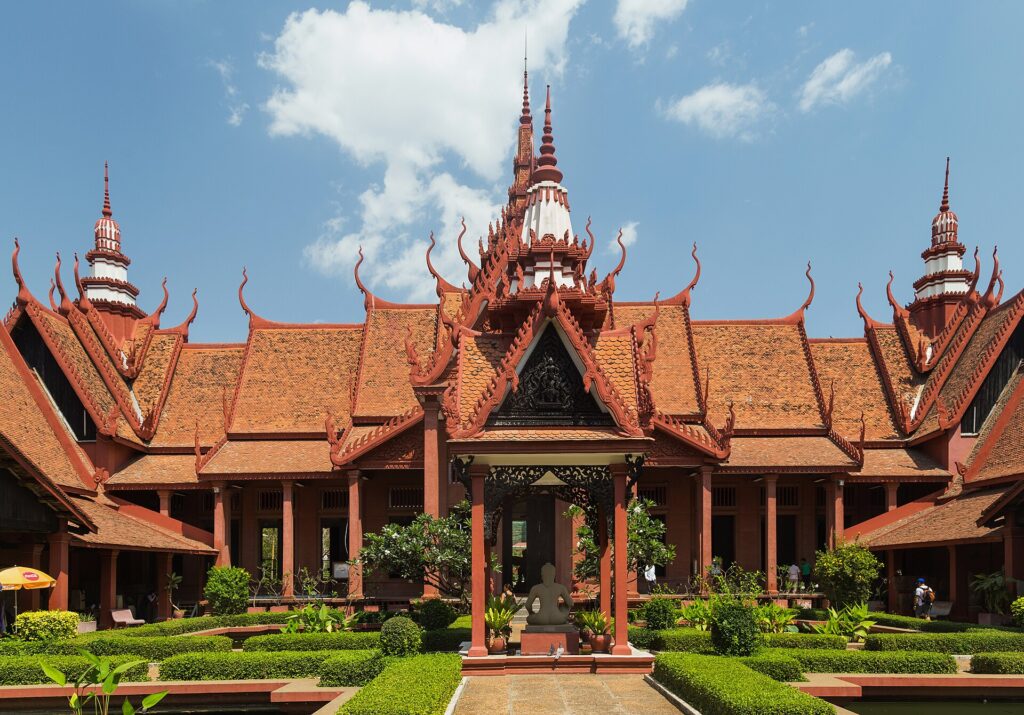
The National Museum of Cambodia in Phnom Penh holds the world's largest collection of Khmer art, more than 14,000 objects from prehistory to the post-Angkor period.…
Where
Corner of Street 13 and Street 178, beside the Royal Palace, Phnom Penh