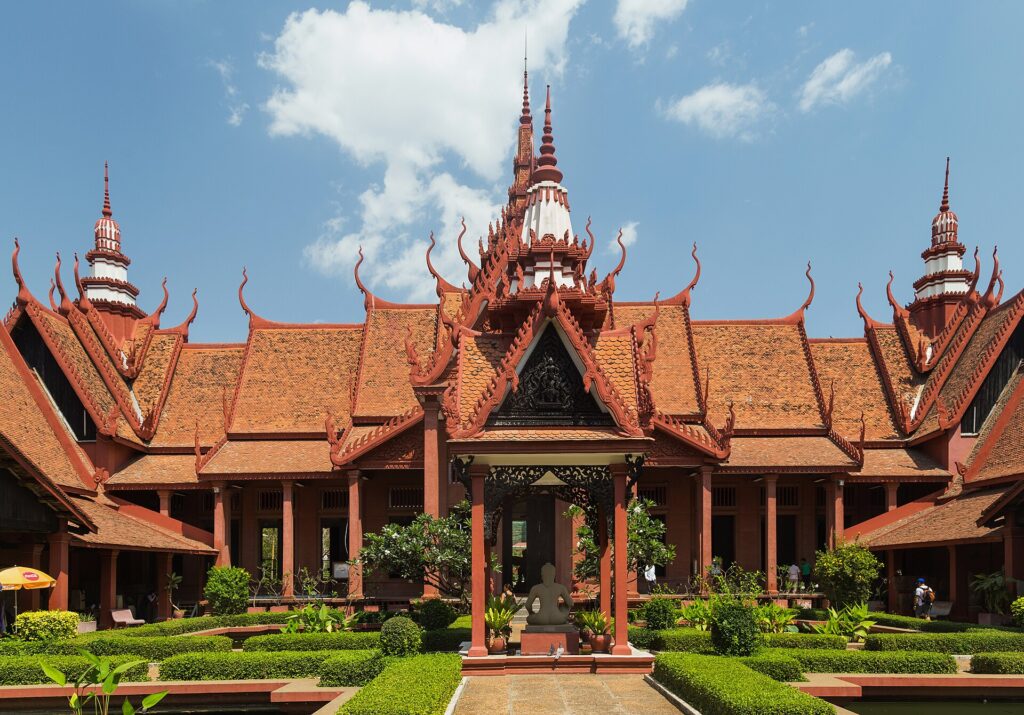
The Royal Palace in Phnom Penh is the official residence of the King of Cambodia, founded by King Norodom in 1866 on the riverfront. Visitors can see the Throne Hall, the palace gardens and the Silver Pagoda, whose floor is laid with 5,329 silver tiles and which houses the Emerald Buddha and a 90-kilogram gold Buddha. Entry for foreigners is $10, and the site is usually open 8 to 11 am and 2 to 5 pm.
Sothearos Boulevard, on the riverfront, Phnom Penh
Founded
1866, by King Norodom
Opening hours
Usually 8:00 to 11:00 am and 2:00 to 5:00 pm daily
Tickets
$10 for foreign visitors, covering palace and Silver Pagoda
Time needed
90 minutes to two hours
Dress code
Shoulders and knees covered, enforced at the gate
Silver Pagoda
5,329 silver floor tiles, the Emerald Buddha and a gold Buddha with 2,086 diamonds
Photography
Not allowed inside the Silver Pagoda or Throne Hall
Pair with
The National Museum, five minutes' walk north
Check
Parts can close for royal ceremonies at short notice
The Royal Palace and Silver Pagoda in Phnom Penh are the official home of Cambodia’s king and the country’s most sumptuous temple. Behind yellow walls on the riverfront you walk through gilded throne halls, manicured gardens and a pagoda floored with more than 5,000 silver tiles.
1866Palace founded by King Norodom
5,329Silver floor tiles
2,086Diamonds on the gold Buddha
$10Foreign visitor ticket
90 minTime to allow
This is a working royal residence, not a museum. King Norodom Sihamoni lives in the private part of the compound, and a blue flag flies when he is in the city. Visitors see the ceremonial buildings and the pagoda, which is more than enough for a very full 90 minutes.
History of the Royal Palace
Phnom Penh became the capital again in the 1860s, when King Norodom moved his court down from Oudong. The palace he began was built on the site of an older citadel at the meeting of the Tonle Sap and Mekong rivers, facing the water as Khmer royal cities traditionally did.
1866
King Norodom moves the royal capital from Oudong to Phnom Penh and begins the new palace.
1876
The iron Napoleon III Pavilion, a gift from the French emperor, is reassembled in the palace grounds.
1892
The first Silver Pagoda, Wat Preah Keo Morakot, is built as the royal temple.
Early 1900s
King Sisowath commissions the gold Buddha, and the great Reamker mural is painted around the pagoda’s gallery.
1917
The present Throne Hall is completed, replacing an earlier wooden hall.
1962
The Silver Pagoda is rebuilt in concrete and marble under Norodom Sihanouk, keeping its original form.
1975 to 1979
The Khmer Rouge leave the compound largely intact to show the outside world that Cambodian culture was being respected. Much of what you see survived for that reason.
2004
King Norodom Sihamoni is crowned in the Throne Hall.
What to see in the palace
You enter the palace section first. The buildings are Khmer in form, with tiered roofs, golden spires and naga finials, but the gardens and some of the detail show the French influence of the period.
The centrepiece
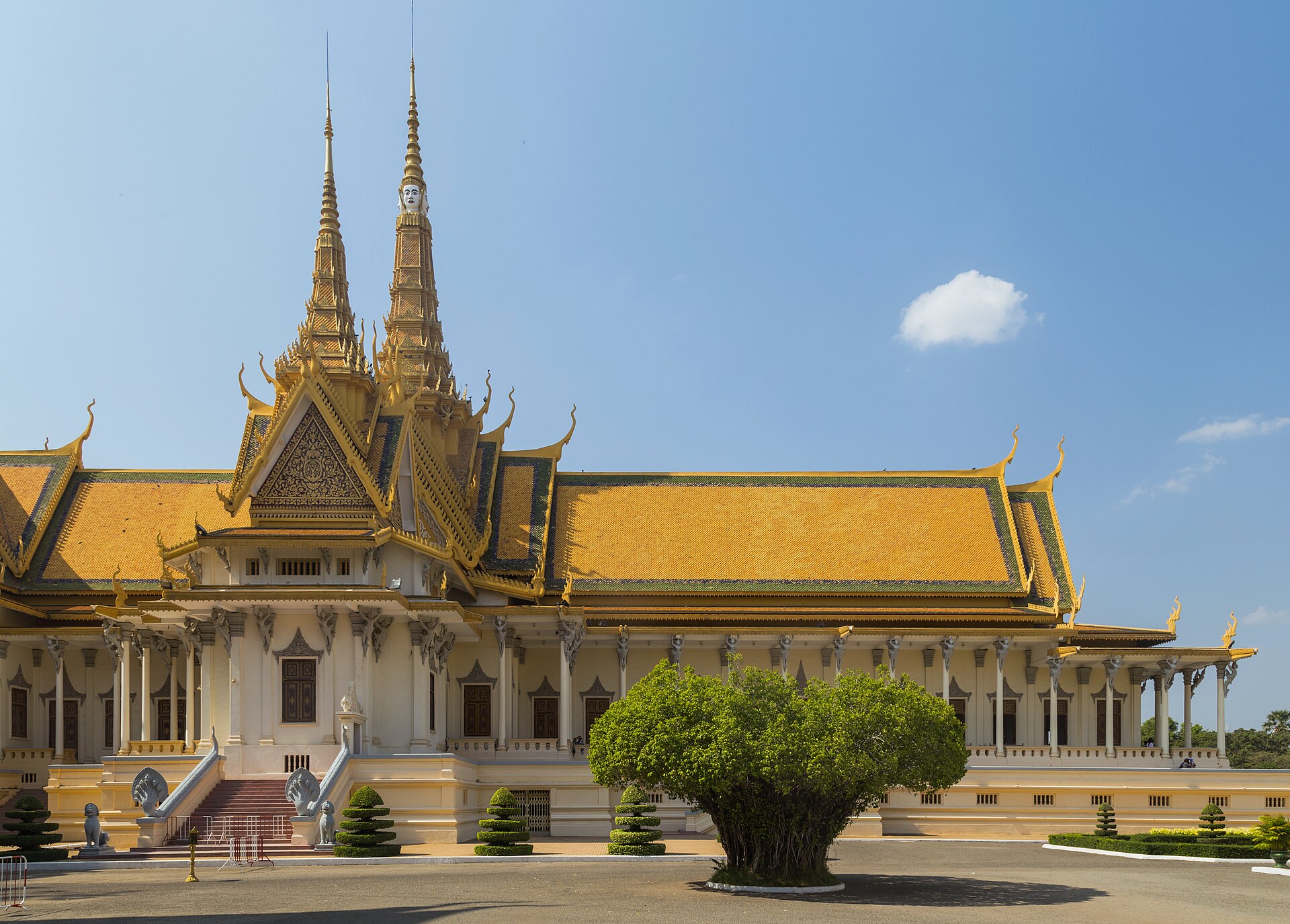
The Throne Hall
Preah Tineang Tevea Vinichhay, crowned by a tall spire modelled on the face towers of the Bayon. It is still used for coronations and royal ceremonies. You look in from the doorways rather than walking inside.
Riverside
The Moonlight Pavilion
Preah Tineang Chan Chhaya, an open pavilion on the palace wall facing Sothearos Boulevard. It was built as a stage for classical dance and is where the king appears to the public on festival days.
Curiosity
The Napoleon III Pavilion
A cast-iron European villa that looks wholly out of place among the Khmer roofs. It was a gift from Napoleon III and was shipped to Cambodia and rebuilt here in 1876.
Gardens
The palace grounds
Lawns, topiary and frangipani trees between the buildings. It is one of the few places in central Phnom Penh with this much space and quiet.
The Khemarin Palace, the king’s residence, lies behind a further wall and is closed to the public. Other buildings may also be shut for ceremonies at short notice.
The Silver Pagoda
A gate on the south side of the palace leads into the Silver Pagoda compound. Its proper name is Wat Preah Keo Morakot, the Temple of the Emerald Buddha. The nickname comes from the floor: 5,329 solid silver tiles, each weighing about a kilogram. Most are covered with carpet to protect them, but a few are left bare near the entrance.
Inside the pagoda
The Emerald Buddha
A small green Buddha on a tall gilded pedestal, said to be made of Baccarat crystal. It is the most sacred image in the kingdom.
Inside the pagoda
The gold Buddha
A life-sized standing Buddha of solid gold, about 90 kilograms, set with 2,086 diamonds. The largest, in the crown, is 25 carats.
The gallery
The Reamker mural
A painted mural more than 600 metres long runs around the compound walls. It tells the Reamker, the Khmer version of the Ramayana. Parts have faded, but it is still extraordinary.
The grounds
Royal stupas
Stupas hold the ashes of King Norodom, King Suramarit and members of the royal family, including Princess Kantha Bopha, daughter of King Sihanouk.
Hilltop
Phnom Mondap
A small artificial hill with a shrine holding a footprint of the Buddha, shaded by trees. Easy to miss, worth the short climb.
Everyday worship
Shrines and offerings
Around the edges are smaller shrines where Cambodians leave lotus, incense and fruit. It is a reminder that this is still a living temple.
Photography is not allowed inside the Silver Pagoda itself. You can photograph the exteriors, the gardens and the mural freely.
Opening hours and tickets
Morning
8:00 am to 11:00 am
Afternoon
2:00 pm to 5:00 pm
Midday
Closed for lunch, 11:00 am to 2:00 pm
Foreign visitors
$10
Children
Young children are often admitted free; confirm at the ticket desk
Guides
Licensed guides can be hired at the entrance
Ticket covers
The palace grounds and the Silver Pagoda compound
Closures
Sections, or the whole site, can close at short notice for royal ceremonies
Most guides agree on the midday closure, but hours have been reported slightly differently in recent years. Confirm locally on the day, and allow for the last tickets to be sold 30 minutes before each session ends.
Dress code and etiquette
The dress code is enforced at the gate. You need sleeves that cover your shoulders and trousers, shorts or a skirt that cover your knees. A scarf over a vest top is usually not accepted. If you arrive unprepared, T-shirts and sarongs are sold near the entrance.
Please do
Cover your shoulders and knees
Take off your shoes and hat before entering the Silver Pagoda
Sit with your feet tucked away from the Buddha images
Stay on the paths and behind the ropes
Please don’t
Take photos inside the Silver Pagoda or the Throne Hall
Walk on the silver tiles where they are roped off
Point your feet at monks or sacred images
Believe anyone outside who tells you the palace is closed today
Tips for your visit
Our advice
Arrive at 8:00 am. The courtyards are paved and shade is scarce. The first hour is cooler and quieter, before tour groups arrive.
Or go at 2:00 pm and stay late. The golden roofs glow in the late-afternoon light, and you can walk to the riverside for sunset afterwards.
Take a guide. There is very little signage. A guide brings the Reamker mural and the royal history to life.
Watch for scams. Tuk-tuk drivers sometimes claim the palace is closed and offer a tour instead. Walk to the gate and check for yourself.
Bring water and a hat for outdoors. Just remember to take the hat off inside the buildings.
On national holidays and during festivals such as the King’s Birthday and the Water Festival, the palace is busier and parts may close. The riverfront outside is at its most festive on those days, though, so the trade-off can be worth it.
How to get there and what is nearby
The palace fills a long block on Sothearos Boulevard, facing the riverside park. The visitor entrance is on Sothearos Boulevard near Street 240. From most central hotels it is a short tuk-tuk ride, and from the riverside you can simply walk. PassApp and Grab both work well in Phnom Penh.
8:00 am Royal Palace and Silver Pagoda, about 90 minutes
The Independence Monument and the Norodom Sihanouk memorial statue are a short walk south-west. In the evening the riverside park in front of the palace fills with families, joggers and food carts, and it is one of the nicest places in the city to spend an hour.
Visiting with My Travel Factory
Our Khmer guides know the palace, its stories and its rules, and time your visit around the heat and the midday closure. The Royal Palace is part of our Phnom Penh & Angkor Discovery and Cambodia Classic Highlights journeys, and we can build it into any private itinerary. Get in touch and we will plan your days in the capital with you.
Questions travellers ask
What are the Royal Palace Phnom Penh opening hours?
It is usually open daily from 8:00 to 11:00 am and 2:00 to 5:00 pm, closing for lunch. Hours can change and the site can close for royal ceremonies, so confirm on the day.
How much is the Royal Palace entrance fee?
Foreign visitors pay $10, which covers both the palace grounds and the Silver Pagoda. Guides can be hired separately at the entrance.
What is the dress code for the Royal Palace?
Shoulders and knees must be covered. Scarves over bare shoulders are usually not accepted, but T-shirts and sarongs are sold near the entrance.
Why is it called the Silver Pagoda?
Its floor is laid with 5,329 solid silver tiles, each weighing about a kilogram. Most are covered with carpet, with a few left visible.
Is the Emerald Buddha really emerald?
No. It is a green crystal figure, said to be Baccarat crystal. The name reflects its colour and its status as the kingdom's most sacred Buddha image.
Can you take photos in the Royal Palace?
Yes, outdoors and of the buildings' exteriors. Photography is not allowed inside the Silver Pagoda or the Throne Hall.
Does the King live in the Royal Palace?
Yes. King Norodom Sihamoni lives in the private Khemarin Palace section, which is closed to visitors. A blue flag flies when he is in residence.
How long do you need at the Royal Palace?
About 90 minutes covers the palace and the Silver Pagoda. With a guide and time for the mural, allow two hours.
Is the Royal Palace worth visiting?
Yes. It is the most beautiful complex in Phnom Penh, and the Silver Pagoda's treasures and mural are unlike anything else in Cambodia.
What is near the Royal Palace?
The National Museum is five minutes' walk north, the riverside park is opposite, and the Independence Monument is a short walk south-west.
The National Museum of Cambodia in Phnom Penh holds the world's largest collection of Khmer art, more than 14,000 objects from prehistory to the post-Angkor period.…
Where
Corner of Street 13 and Street 178, beside the Royal Palace, Phnom Penh
Opened
13 April 1920, designed by George Groslier
Read more
Free, no-obligation enquiry
Tell us about your trip
Enquiry received
Thank you — a local specialist will be in touch within 24 hours.