Breaking the Phnom Penh to Siem Reap drive with pre-Angkorian temples
Temples and ruinsType
In short
Sambor Prei Kuk is the site of Ishanapura, capital of the Chenla kingdom in the late 6th and early 7th centuries, about 30 km north of Kampong Thom. It has more than 180 brick temples in open forest, including 11 rare octagonal towers, and was inscribed as a UNESCO World Heritage Site in 2017. It is the ideal stop on the drive between Phnom Penh and Siem Reap.
Kampong Thom province, 30 km north of Kampong Thom town
Ancient name
Ishanapura, capital of the Chenla kingdom
Built
Late 6th to early 7th century, about 200 years before Angkor
Temples
More than 180 brick temples, including 11 octagonal towers
Main groups
Prasat Sambor (North), Prasat Tao (Central), Prasat Yeay Poan (South)
UNESCO
World Heritage Site, inscribed 8 July 2017
Entry fee
$10 for foreign visitors; confirm locally
Opening hours
Every day, 7:30 am to 5:30 pm
Time needed
Two to three hours
From Siem Reap or Phnom Penh
About three to four hours by car
Sambor Prei Kuk is the site of Ishanapura, capital of the Chenla kingdom in the late 6th and early 7th centuries, some two hundred years before Angkor. More than 180 brick temples stand scattered through open forest 30 kilometres north of Kampong Thom. It has been a UNESCO World Heritage Site since 2017.
7th centuryMain building period
180+Brick temples recorded
11Rare octagonal temples
30 kmNorth of Kampong Thom
2017UNESCO World Heritage
The name means “the temple in the richness of the forest”, and that is exactly how it feels. Instead of grey sandstone and crowds, you find rust-red brick towers under tall dipterocarp trees, some wrapped in strangler figs, with birdsong and the odd cow for company. It is one of the most rewarding stops in Cambodia and still one of the least visited.
History of Sambor Prei Kuk
After the decline of Funan, the early states of the Mekong region were known to Chinese chroniclers as Chenla. Its kings built their capital, Ishanapura, beside the Stung Sen river. Under King Isanavarman I, who reigned in the early 7th century, it became the political and religious centre of a large territory.
Late 6th century
Building begins at Ishanapura, the Chenla capital, on the Stung Sen river.
Early 7th century
Isanavarman I rules from Ishanapura. The southern and northern groups of temples take shape, along with walls, moats and reservoirs.
7th to 9th centuries
Chenla fragments into smaller states. The city remains an important religious centre.
Angkor period
The city is no longer a capital, but the site stays in use and occupation continues for centuries.
Early 1970s
During the war, bombing leaves craters near the temples. Landmines are laid in the area.
2008
The last landmines are cleared from the site.
8 July 2017
UNESCO inscribes the Temple Zone of Sambor Prei Kuk, Archaeological Site of Ancient Ishanapura, as a World Heritage Site.
UNESCO recognises Sambor Prei Kuk for its role in shaping later Khmer art and architecture. The Sambor Prei Kuk style of carving, with its elegant lintels and early narrative reliefs, is the root from which the art of Angkor grew. Inscriptions here also carry some of the earliest expressions of the Khmer idea of divine kingship.
The three temple groups
The temple zone covers several square kilometres. Archaeologists divide the main temples into three groups, North, Central and South, each once enclosed by its own brick walls. Sandy paths through the forest link them, and the loop is flat and easy.
Group N
Prasat Sambor
The northern group, around a large central tower. Many of the site’s octagonal shrines are here, along with finely carved lintels.
Group C
Prasat Tao
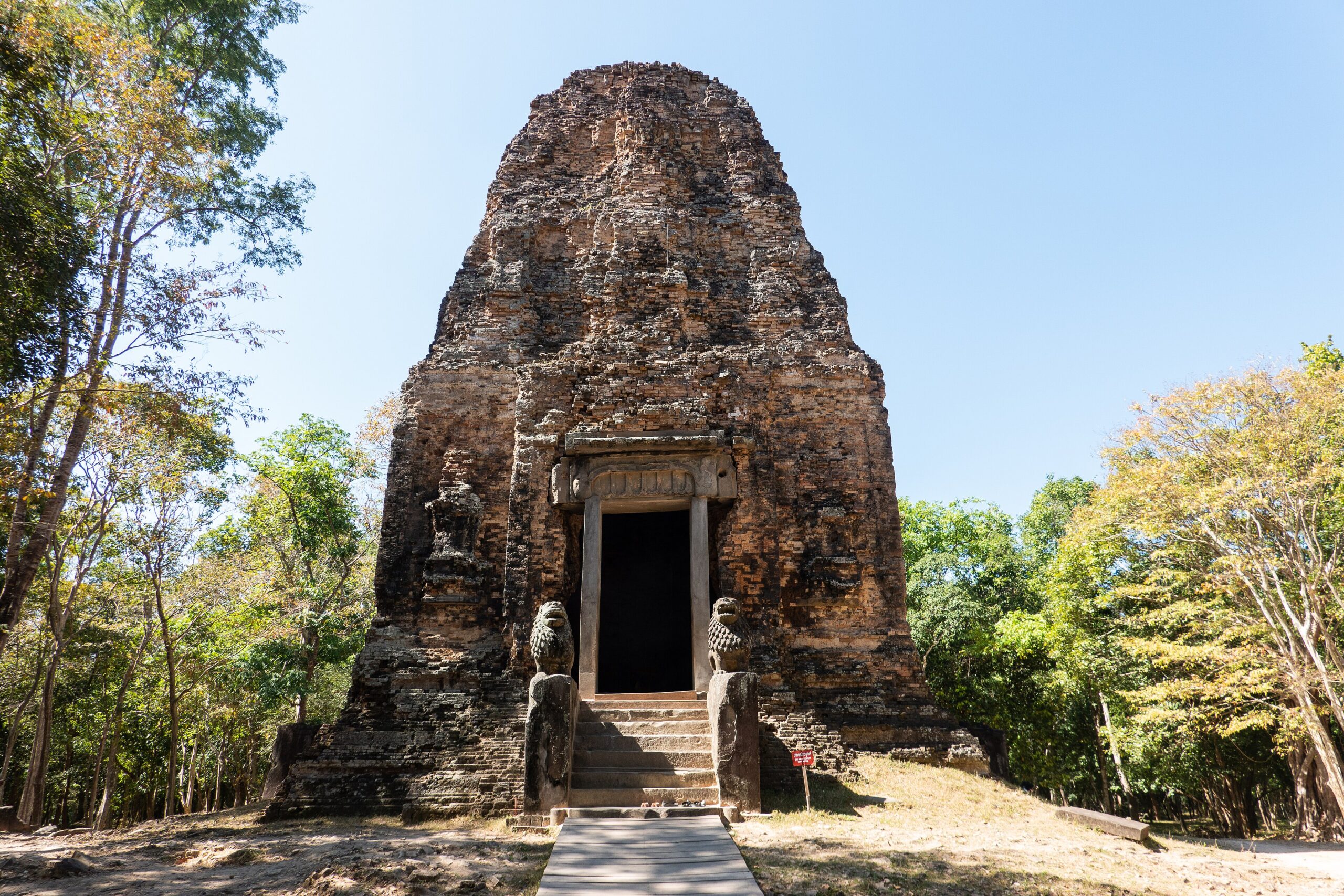
The Lions’ Temple, a tower on a stepped platform guarded by elegant stone lions. The best-known image of the site.
Group S
Prasat Yeay Poan
The southern group, with the best-preserved enclosure walls and brick reliefs, including the famous carved “flying palaces”.
Beyond the three main groups dozens of smaller towers are scattered through the trees. Some stand alone in clearings, some are held together by the roots of great fig trees. Wandering between them is half the pleasure.
Highlights not to miss
Unique
Octagonal towers
Eleven eight-sided temples survive here. UNESCO notes there is no known precedent for them in India, and they are found nowhere else in the Khmer world.
Carving
Flying palaces
Brick reliefs of miniature palaces with figures inside, set into the outer walls. They are among the earliest narrative carving in Cambodia.
Photogenic
The tree temple
A small brick shrine almost completely swallowed by a strangler fig, one of the most memorable sights on the loop.
Detail
Medallions and lintels
Round carved medallions on the walls and sandstone lintels over the doorways show the style that Angkor’s carvers built on.
Many of the finest statues and lintels from Sambor Prei Kuk are now in the National Museum of Cambodia in Phnom Penh, which makes a good companion visit.
Tickets and opening hours
Entry fee
$10 for foreign visitors; confirm locally
Angkor Pass
Not valid; ticketed separately
Opening hours
Every day, 7:30 am to 5:30 pm
Payment
Cash, US dollars or riel
Time needed
Two to three hours for the three main groups
Getting around
On foot, by bicycle or by car along sandy forest tracks
Facilities
Toilets, drink stalls and simple food near the ticket area
How to get there
Sambor Prei Kuk is in Kampong Thom province, about 30 kilometres north of Kampong Thom town on a sealed road. Kampong Thom lies on National Road 6, almost exactly halfway between Phnom Penh and Siem Reap, which makes the temples the natural stop on that journey.
From Kampong Thom: 40 minutes to an hour by car or tuk-tuk
From Siem Reap: about three hours by car
From Phnom Penh: about three and a half to four hours by car
Buses between Phnom Penh and Siem Reap stop in Kampong Thom, where you can hire a tuk-tuk or moto for the last stretch. With a private car, the detour from Road 6 adds only an hour or so of driving to the day.
A suggested visit
This is how we usually fit Sambor Prei Kuk into a transfer day between the two cities:
7:00 am Leave Phnom Penh or Siem Reap by car
10:00 am Arrive at Sambor Prei Kuk and start with the southern group
11:00 am Walk or cycle through the forest to Prasat Tao and the northern group
12:30 pm Lunch at a local restaurant near the site or in Kampong Thom
1:30 pm Continue on Road 6, arriving by late afternoon
For a slower pace, stay a night. Local families in the village near the temples offer simple homestays, and you can have the forest almost to yourself in the early morning and late afternoon.
Tips for your visit
Our advice
Hire a bicycle or a local guide. Bikes make the loop easy, and local guides from the village know every tower and its story.
Go in the morning or late afternoon. The forest gives shade, but the middle of the day is hot. Low sun makes the brick glow.
Bring insect repellent. Mosquitoes can be lively in the forest, especially after rain.
Visit in the dry season if you can. November to March is easiest. In the wet season the forest is beautiful but some tracks get muddy.
Keep to paths. The area has been cleared of landmines, but the forest floor is uneven and snakes are about.
Please do
Cover your shoulders and knees
Buy water and snacks from local stalls
Use community guides and homestays; they support the village
Take your rubbish with you
Please don’t
Climb on the brick towers or into fragile ones
Touch or lean on carved reliefs
Pull at roots or vines on the tree-covered temples
Fly a drone without permission
Visiting with My Travel Factory
We build Sambor Prei Kuk into the road journey between Phnom Penh and Siem Reap so that a long transfer becomes one of the highlights of the trip. It features in our Cradle of the Khmer and Hidden Temples of the Heartland journeys, with a private guide and driver. See also our heritage experiences and Angkor Wat, the temple it all led to.
Questions travellers ask
What is Sambor Prei Kuk?
The remains of Ishanapura, the 7th-century capital of the Chenla kingdom, with more than 180 brick temples in forest north of Kampong Thom.
Is Sambor Prei Kuk worth visiting?
Yes, especially if you are travelling between Phnom Penh and Siem Reap. It is quiet, beautiful and shows where Khmer architecture began.
How old is Sambor Prei Kuk?
Its main temples date from the late 6th and early 7th centuries, about two hundred years before the first temples at Angkor.
How much is the Sambor Prei Kuk entrance fee?
$10 for foreign visitors at the time of writing. Confirm locally, as fees can change.
Is Sambor Prei Kuk on the Angkor Pass?
No, it has its own ticket.
How do I get to Sambor Prei Kuk?
Drive to Kampong Thom on National Road 6, then 30 km north on a sealed road. From Kampong Thom a tuk-tuk takes 40 minutes to an hour.
How long do I need at Sambor Prei Kuk?
Two to three hours covers the three main groups. Stay longer if you want to explore the smaller forest temples.
When did Sambor Prei Kuk become a World Heritage Site?
UNESCO inscribed it on 8 July 2017, as Cambodia's third World Heritage Site.
Can I stay overnight at Sambor Prei Kuk?
Yes. Local families in the village offer simple homestays, and Kampong Thom town has hotels.
What makes Sambor Prei Kuk different from Angkor?
The temples are built of brick rather than sandstone, are much older, and include octagonal towers found nowhere else.
Preah Vihear Temple is an 11th-century Khmer sanctuary to Shiva, built along an 800-metre axis on the Dangrek escarpment at Cambodia's border with Thailand, ending at…
Status
Closed to visitors since July 2025; no reopening date announced
Location
Dangrek escarpment, Preah Vihear province, on the Thai border