Artisans Angkor is a Siem Reap social enterprise, founded as a vocational school in 1992, that trains young rural Cambodians in traditional Khmer crafts such as stone and wood carving, lacquer, gilding and silk weaving. Visitors can take free guided tours of its craft centre on Stung Thmey Street in town, and of the Angkor Silk Farm in Puok, about 16 km away, where you see every stage from mulberry to loom.
Craft centre on Stung Thmey Street, central Siem Reap; silk farm in Puok on National Road 6
Entry
Free, including guided tours at both sites
Craft centre hours
Daily, 7:30 am to 6:00 pm
Silk farm hours
Daily, 7:30 am to 5:30 pm
Silk farm shuttle
Free, usually 9:30 am and 1:30 pm from town; book ahead
Time needed
About an hour at each site, half a day for both
Crafts
Stone and wood carving, lacquer, gilding, silver plating, silk painting, silk weaving
Founded
1992 as Les Chantiers-Écoles; Artisans Angkor company since 2003
Best time
Mid-morning on a working day, when studios are busiest
Good for
Families, craft lovers and anyone shopping for genuine Cambodian souvenirs
Artisans Angkor is a Siem Reap social enterprise that trains young Cambodians in the traditional crafts of the Khmer Empire: stone and wood carving, lacquer, gilding and silk. Its craft centre in town and its silk farm in Puok are both open to visitors every day, with free guided tours through working studios.
FreeEntry and guided tours
7:30 amWorkshops open daily
1992Training school founded
5 hectaresOf mulberry at the silk farm
20 to 30 minFrom town to the silk farm
Most people come to Siem Reap for the temples and leave with a carved Buddha or a silk scarf from a market stall. A visit here changes how you look at both. You see how long it takes to carve a single apsara, and how many steps lie between a mulberry leaf and a finished length of silk. After that, the difference between real craft and a cheap copy is obvious.
How Artisans Angkor began
1992
Cambodia’s Ministry of Education sets up Les Chantiers-Écoles de Formation Professionnelle, a vocational school in Siem Reap. After decades of war, it first trains young people in building trades for reconstruction.
1993
The National Silk Centre creates the silk farm in Puok district, to revive Cambodian sericulture and weaving.
Mid-1990s
The school extends its teaching to traditional Khmer crafts, many of which had almost disappeared under the Khmer Rouge.
1998 to 2001
A European Union programme funds the creation of workshops and a way for graduates to earn a living from their craft. The name Artisans Angkor is born.
2003
Artisans Angkor becomes an autonomous, semi-public company, with support from the French Development Agency.
2005 to 2012
Its products win a series of UNESCO Awards of Excellence for handicrafts.
By 2013 the company employed more than 1,300 people, around 900 of them craftspeople in 48 workshops across Siem Reap province, most in villages close to the artisans’ homes. Training is free for young people from rural families, typically aged 18 to 25. The artisans themselves hold a share in the company, and profits go back into training and wages.
The craft centre in town
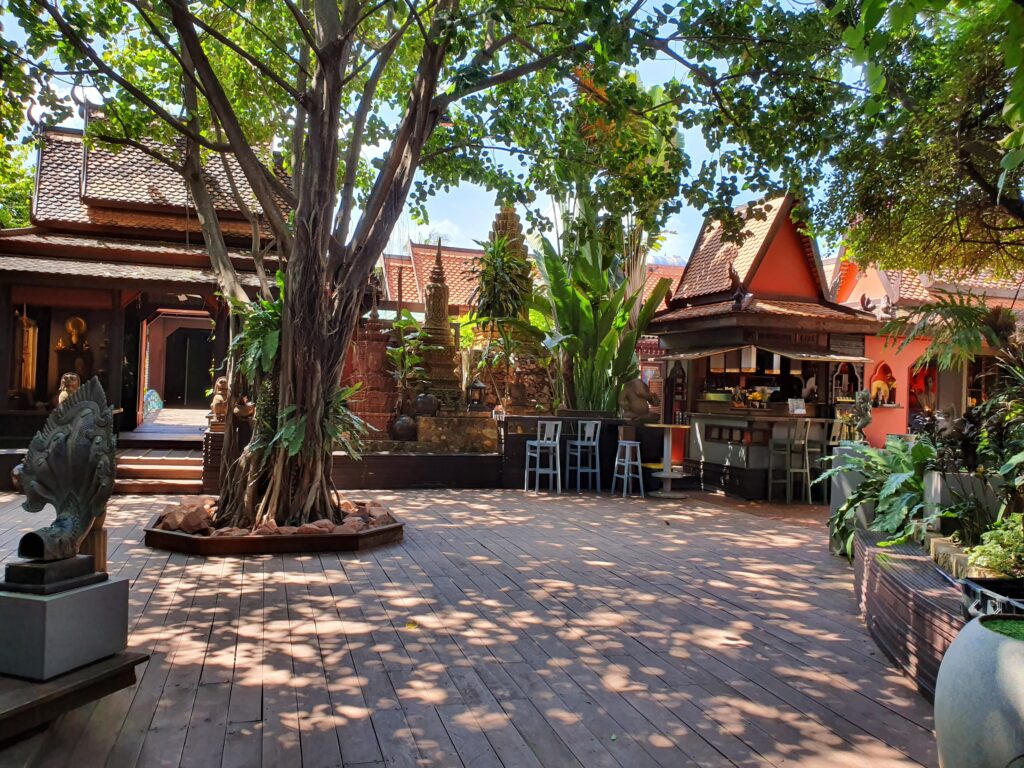
The main campus, known locally as the Chantiers-Écoles, is in a quiet garden compound on Stung Thmey Street, just off Sivatha Boulevard and a short walk from the Old Market. It is open daily, and English-speaking guides take you through the studios free of charge.
This is a working training centre, not a stage set. Apprentices sit alongside master craftsmen, masks against the dust, and the guides explain each stage as you watch. You can take photos, but ask before photographing anyone close up.
Stone
Stone carving
Sandstone blocks slowly become Buddhas, apsaras and temple lintels, carved by hand using the motifs and proportions of Angkor’s own sculpture.
Wood
Wood carving
Carvers work from paper templates copied onto the timber, then cut, chisel and sand by hand. Watch how long a single face takes to emerge.
Lacquer
Lacquerware
Bowls, boxes and panels are built up in many thin layers of lacquer, each dried and polished before the next. It is patient, precise work.
Metal and gold
Gilding and silver plating
Gold and silver leaf are laid over carved wood to create the shimmering statues and ornaments seen in Cambodian pagodas.
Paint
Silk painting
Artists paint on silk and canvas, often recreating Angkorian scenes and Siem Reap riverscapes in rich colour.
Clay
Ceramics
Potters shape and glaze Khmer-style ceramics, a craft with roots in the kilns that supplied Angkor itself.
Allow about an hour for the tour, plus time in the shop at the end.
The Angkor Silk Farm
The silk farm lies in Puok district on National Road 6, about 16 kilometres north-west of the town centre, and takes 20 to 30 minutes by road. It is the best place near Siem Reap to see the whole life of Cambodian silk, from leaf to loom, in one visit.
A guide walks you through each stage in turn:
Mulberry The farm is surrounded by 5 hectares of mulberry bushes, the only food the silkworms eat
Silkworms Trays of worms feeding and spinning cocoons of golden Cambodian silk
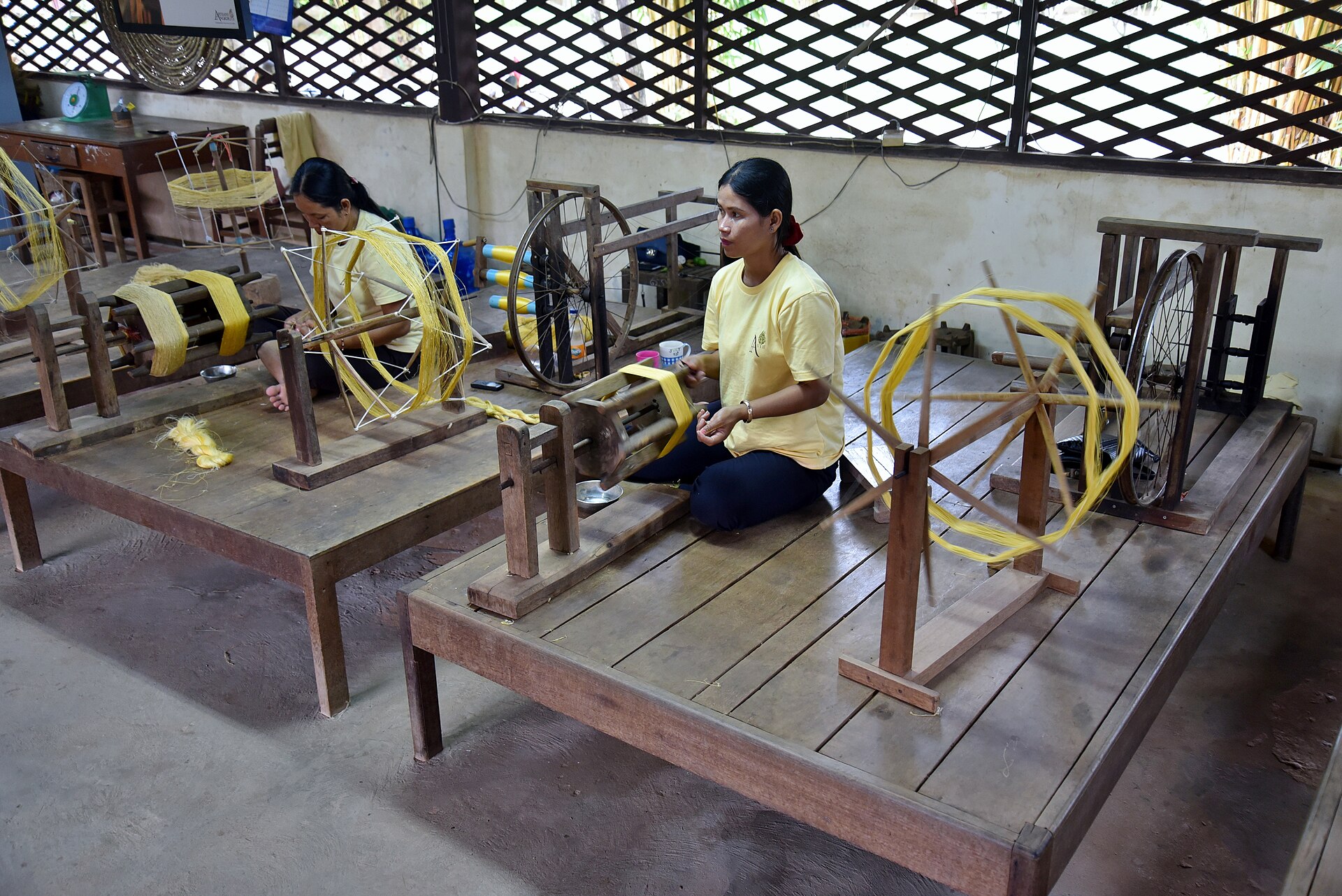
Reeling Cocoons are softened in hot water and the fine thread is wound off by hand on wooden wheels
Dyeing Threads are dyed with natural colours from bark, seeds, leaves and insects, laid out for you to see
Ikat tying Sections of thread are tied off before dyeing so the pattern appears when woven, the Cambodian technique called hol
Weaving A long hall of wooden looms where weavers produce sampot, scarves and fabric, one thread at a time
The gardens are pleasant and shady, and a visit takes about an hour. The weavers you meet are paid artisans, and many come from villages nearby.
Opening hours, tours and shuttle
Craft centre, Siem Reap
Stung Thmey Street. Daily guided tours from 7:30 am to 6:00 pm
Angkor Silk Farm, Puok
National Road 6. Open daily from 7:30 am to 5:30 pm
Entry
Free at both sites, including the guided tour
Free shuttle to the silk farm
From the town centre, usually at 9:30 am and 1:30 pm. Book ahead on +855 12 222 404
Tuk-tuk to the silk farm
About $15 to $20 return with waiting time; confirm locally
Time needed
About an hour at each site; half a day for both
Languages
Tours in English and Khmer; ask about other languages
Hours and shuttle times can change, especially in the low season, so confirm them the day before.
Our advice
Visit in the morning. The studios are at their busiest and the air is cooler. Studios can be quiet over the lunch hour.
Check holidays. Around Khmer New Year and Pchum Ben fewer artisans may be at work, so confirm locally before you go.
Combine it with a temple rest. After an early start at Angkor, the craft centre is a cool, shady way to spend late morning.
Ask questions. The guides are knowledgeable and happy to explain techniques, training and wages.
Buying well
Each site has a shop, and prices are higher than in the markets. You are paying for pieces made by hand in Cambodia by artisans on fair wages, and it shows in the finish. There is no hard sell. Ask in the shop about delivery if you fall for something large.
Artisans Angkor also has boutiques at Siem Reap and Phnom Penh airports and in Phnom Penh. If you want a silk scarf or a small carving to take home, this is where to buy it with confidence.
Please do
Ask before taking close-up photos of artisans
Keep a respectful distance from tools and machinery
Buy what you love, knowing where it was made
Please don’t
Touch carvings in progress or wet lacquer
Use flash in the studios
Assume market “silk” is the same thing; much is imported or synthetic
How to fit it into your stay
The craft centre is in the middle of town, so it fits almost anywhere. Many guests visit it on the way to lunch, or on the afternoon they arrive. The silk farm works well as a morning trip on a rest day between temples, or on the way to or from the airport, as both lie west of town.
If you are travelling with children, the silk farm is the better choice. The silkworms and cocoons are a hit, and there is space to wander. For an evening in the same spirit, book Phare, The Cambodian Circus, another social enterprise training young Cambodians. And if you still want to browse, the night markets around Pub Street are a short walk from the craft centre. See more of our heritage experiences.
Visiting with My Travel Factory
We include Artisans Angkor on many of our Siem Reap journeys, with a private guide who can take you through both the craft centre and the silk farm, and time to shop without hurry. It sits naturally in our Siem Reap Slow Travel and Siem Reap Green Journey itineraries. Tell us what you would like to see and we will shape the day around it.
Questions travellers ask
What is Artisans Angkor?
A social enterprise in Siem Reap that trains young Cambodians from rural families in traditional Khmer crafts and employs them in its workshops. It grew out of a vocational school founded in 1992.
Is Artisans Angkor free to visit?
Yes. Entry and guided tours are free at both the craft centre in town and the Angkor Silk Farm.
What are the opening hours of Artisans Angkor?
The craft centre runs daily guided tours from 7:30 am to 6:00 pm. The silk farm opens daily from 7:30 am to 5:30 pm. Confirm locally on public holidays.
Where is the Angkor Silk Farm?
In Puok district on National Road 6, about 16 km north-west of central Siem Reap, a 20 to 30 minute drive.
Is there a free shuttle to the silk farm?
Yes, usually at 9:30 am and 1:30 pm from the town centre. Book ahead by phone on +855 12 222 404, as seats are limited.
How long does a visit take?
About an hour at the craft centre and about an hour at the silk farm, plus travel. Allow half a day to see both.
What can you see at the silk farm?
The whole silk process: mulberry fields, silkworms and cocoons, reeling, natural dyeing, ikat tying and weaving on wooden looms.
Is it just a shop with a tour?
No. The workshops are real training and production studios. There is a shop at the end, but no pressure to buy.
Are Artisans Angkor products expensive?
They cost more than market goods because they are handmade in Cambodia by trained artisans on fair wages. The quality difference is clear.
Is Artisans Angkor good for children?
Yes, especially the silk farm, where children enjoy seeing the silkworms and cocoons and there is space to wander.
Can I take photos in the workshops?
Yes, but avoid flash and ask before taking close-up photos of the artisans.
Banteay Kdei is a late 12th-century Buddhist monastery temple in the Angkor Archaeological Park, built by King Jayavarman VII in the Bayon style. It lies just…
Where
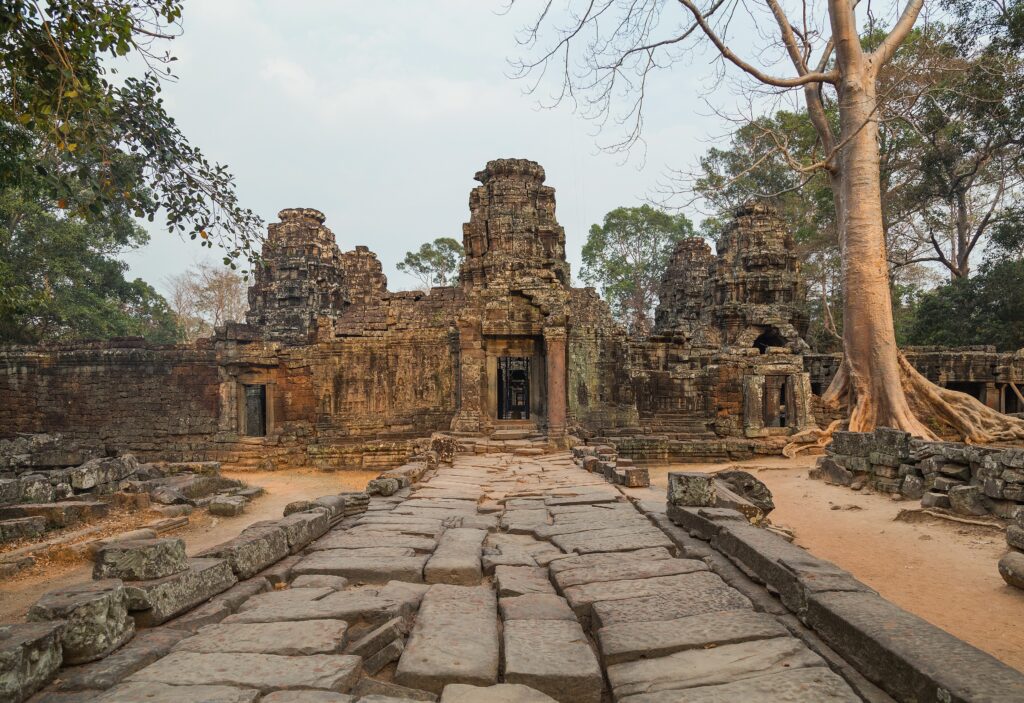
Small Circuit, Angkor Archaeological Park, just east of Ta Prohm
Cambodia Wildlife Sanctuary is an elephant rescue and forest conservation project about 100 km north of Siem Reap, developed with the Save Elephant Foundation. It protects…
Where
About 100 km north of Siem Reap, on the edge of Kulen Promtep Wildlife Sanctuary