The Tuol Sleng Genocide Museum is the former S-21 prison in central Phnom Penh. A high school until 1975, it was turned by the Khmer Rouge into their main interrogation centre, where between 15,000 and 20,000 people were held and only 12 are known to have survived. Preserved as it was found in 1979, it is open daily from 8am to 5pm and has been part of a UNESCO World Heritage Site since July 2025.
Street 113 (corner of Street 350), Boeung Keng Kang, Phnom Penh
Opening hours
Daily, 8:00 am to 5:00 pm
Tickets
$5 foreign adults; $3 ages 10 to 17; free under 10 and for Cambodians. Cash only
Audio guide
$5, in 11 languages including English, French, German, Chinese and Japanese
Time needed
Two to three hours with the audio guide
Best time
8:00 am opening, before the heat and the groups
Dress code
Shoulders and knees covered
Age
The museum advises the exhibits are unsuitable for under-14s
UNESCO
World Heritage Site since 2025 (Cambodian Memorial Sites); archives on the Memory of the World register since 2009
Pair with
Choeung Ek Killing Fields, 15 km south; visit Tuol Sleng first
The Tuol Sleng Genocide Museum is a former high school in central Phnom Penh. From 1975 to 1979 the Khmer Rouge ran it as Security Office 21 (S-21), their main prison and interrogation centre. Today it is a memorial, kept very much as it was found in January 1979.
1962Built as a school
1975 to 1979Used as the S-21 prison
15,000 to 20,000People held here
12Known survivors
2025UNESCO World Heritage
It is not a museum in the usual sense. There are few glass cases and almost no reconstruction. You walk through the classrooms, corridors and cells themselves. Most people who visit Phnom Penh say it is the single most important thing they did in the city, and the hardest.
History: from school to S-21
1962
The campus opens as two neighbouring schools: the Ponhea Yat high school, later renamed Tuol Svay Prey High School, and Tuol Sleng Primary School. It has four long, three-storey classroom blocks around a grassy courtyard.
17 April 1975
The Khmer Rouge take Phnom Penh and empty the city within days.
1975 to 1976
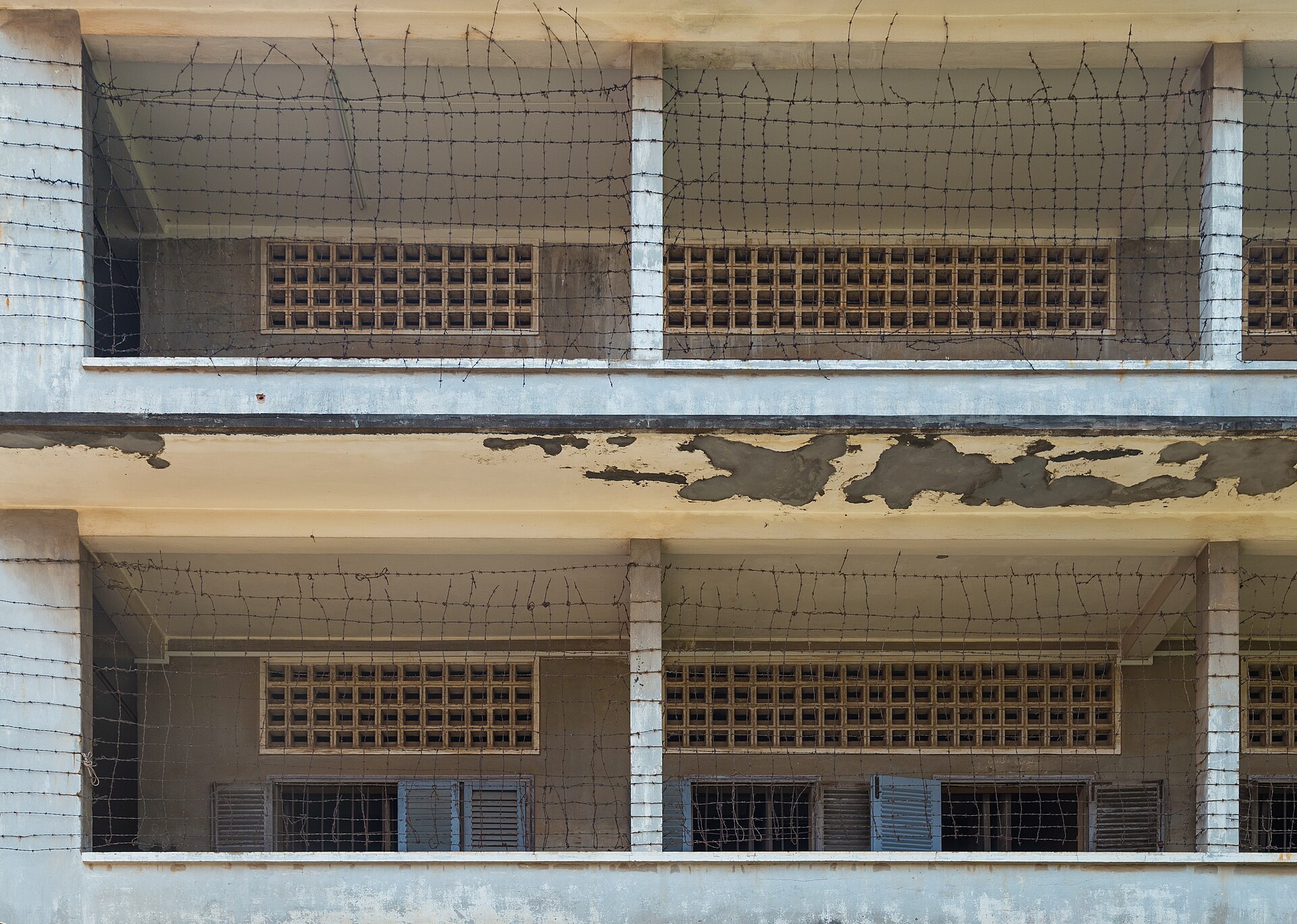
S-21 is set up and moves into the empty school. Classrooms are divided into cells and the balconies are closed in with barbed wire.
1975 to 1979
The prison is run by Kaing Guek Eav, a former mathematics teacher known as Comrade Duch. According to the museum, about 1,720 people work there as guards, interrogators, photographers, typists and medical staff.
7 January 1979
Vietnamese troops and Cambodian forces opposed to the Khmer Rouge take Phnom Penh. Within days they find the abandoned prison, with the last victims still in the rooms of Building A.
1979 to 1980
The site opens as the Tuol Sleng Genocide Museum.
2009
The Tuol Sleng archives are added to UNESCO’s Memory of the World register.
2010 to 2012
Duch is convicted by the UN-backed tribunal (ECCC) of crimes against humanity and grave breaches of the Geneva Conventions. On appeal his sentence becomes life imprisonment. He dies in custody in 2020.
11 July 2025
Tuol Sleng becomes part of a UNESCO World Heritage Site.
What happened at S-21
The museum records that between 15,000 and 20,000 people were held at S-21. Other estimates vary; the United States Holocaust Memorial Museum gives 14,000 to 17,000.
The prisoners included:
farmers, teachers, students, doctors and engineers
many Khmer Rouge cadres and soldiers, suspected as the regime turned on its own ranks
their families, often including children
foreign nationals, including Vietnamese, Thai, French, American, Australian, British and New Zealand citizens, none of whom survived
On arrival, prisoners were photographed, numbered and made to write out their life stories. Most were then interrogated under torture until they signed a confession. These confessions usually named other people, which led to more arrests. Most prisoners were later taken by truck to Choeung Ek, about 15 kilometres south of the city, and killed there.
The survivors
According to the museum, only 12 people are known to have survived S-21, four of them children. Some adults were kept alive because they had a skill the prison could use:
Vann Nath painted portraits of the regime’s leader.
Chum Mey could repair sewing machines and typewriters.
Bou Meng was also kept alive to paint.
UNESCO World Heritage status
On 11 July 2025, at its 47th session, the World Heritage Committee added the Cambodian Memorial Sites to the World Heritage List under criterion (vi), for their link to events of universal significance. There are three sites:
the former M-13 prison in Kampong Chhnang province
the Tuol Sleng Genocide Museum
the Choeung Ek Genocidal Centre
It is Cambodia’s fifth World Heritage Site, after Angkor, Preah Vihear, Sambor Prei Kuk and Koh Ker. It is the first that relates to the country’s recent history rather than its ancient temples.
What you see, building by building
The four former classroom blocks are lettered A to D. The visit and the audio guide follow them in that order.
Building A
The interrogation rooms
Cells used for senior prisoners. Each room holds an iron bed frame and a photograph of the room as it was found in 1979. The quietest part of the museum, and for many the hardest.
Building B
The portraits
Rows of the photographs taken of prisoners on arrival: men, women, teenagers and children, each with a number. Many were once Khmer Rouge members themselves.
Building C
The cells
Balconies still enclosed in barbed wire. Inside, classrooms divided into tiny brick and wooden cells, about 0.8 metres by 2 metres, where prisoners were chained to the floor.
Building D
The evidence
Instruments used in the prison and the paintings of survivors Vann Nath and Bou Meng, which record scenes no camera did. The White Lotus Room for quiet reflection is here.
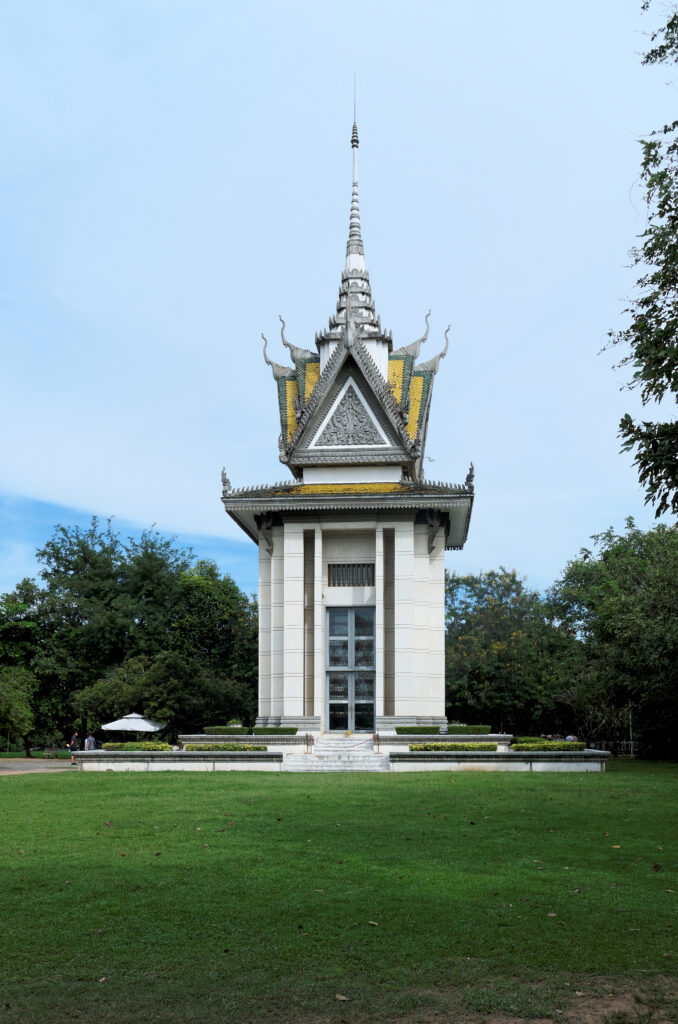
The courtyard. Between the blocks are the 14 white graves of the last victims, a memorial stupa, a tall wooden frame that once held the school’s exercise equipment, and a board of the prison’s security regulations. Benches under the trees give you somewhere to sit between buildings.
Opening hours, tickets and audio guide
Opening hours
Every day, 8:00 am to 5:00 pm
Foreign adults (18+)
$5
Children aged 10 to 17
$3
Children under 10
Free, with ID
Cambodian nationals
Free
Audio guide
$5 for international visitors
Payment
Cash only, US dollars or riel
Time needed
Two to three hours with the audio guide
Survivor testimony
Monday, Wednesday and Friday, 2:30 to 3:00 pm
Documentary films
Weekdays at 10:15 am and 3:15 pm, Building E
Our advice
Arrive at 8:00 am. The site is almost all open-air walkways and gets very hot by midday. You also beat the tour groups.
Take the audio guide. It includes the voices of survivors and former staff, and it turns a walk through empty rooms into an account of what happened in them. It comes in Khmer, English, French, German, Chinese, Vietnamese, Korean, Japanese, Spanish, Dutch and Italian.
Allow more time than you plan. Many people plan for 90 minutes and stay longer.
Survivors have often been at the museum in person, sometimes with copies of their memoirs. Who is there on any given day varies, so treat a meeting as a privilege rather than something to plan around.
Rules and etiquette
Please do
Cover your shoulders and knees, as you would for a temple
Keep your voice low
Take the audio guide and move at your own pace
Sit in the courtyard if you need a break
Please don’t
Bring food or alcohol, smoke or vape
Use your phone inside the exhibition buildings
Fly a drone without permission
Take selfies or posed photos, or photograph the portraits
Children. The museum says the exhibits are unsuitable for visitors under 14. Teenagers who have been prepared for the visit usually find it deeply meaningful. Younger children are better off doing something else that morning with one parent.
How to get there
The museum is on Street 113 at the corner of Street 350, in the Boeung Keng Kang district. From the riverside, the Royal Palace or the Russian Market it is a 10 to 20 minute tuk-tuk ride. PassApp and Grab both work well in Phnom Penh if you would rather book on your phone.
Tuol Sleng and Choeung Ek together
Most visitors see both sites in one morning:
8:00 am Tuol Sleng Genocide Museum, two to three hours
This is the order events happened in, and each site makes more sense after the other. A private driver or tuk-tuk for the half day is the easiest way to do it. Leave the afternoon free: few people feel like more sightseeing straight afterwards.
Visiting with My Travel Factory
On our private tours, a Khmer guide takes you through Tuol Sleng and Choeung Ek. Many of our guides grew up with these stories in their own families. They give the context the rooms cannot, and they leave you space when you need it. The visit is part of our Phnom Penh & Angkor Discovery and our Phnom Penh history day, and we can add it to any Cambodia itinerary.
Questions travellers ask
What is the Tuol Sleng Genocide Museum?
It is the former S-21 prison in Phnom Penh, a high school that the Khmer Rouge turned into their main interrogation and detention centre between 1975 and 1979. Since 1979 it has been preserved as a museum and memorial to the people held there.
What are the opening hours of the Tuol Sleng Genocide Museum?
The museum is open every day from 8:00 am to 5:00 pm. Arriving at opening time is best, as the site is mostly open-air and gets hot by late morning.
How much is the entrance fee for Tuol Sleng?
Foreign adults pay $5, children aged 10 to 17 pay $3, and children under 10 and Cambodian nationals enter free. The audio guide costs $5 for international visitors. Payment is cash only, in US dollars or riel.
Is the Tuol Sleng audio guide worth it?
Yes. It includes the voices of survivors and former staff, follows the buildings in order and explains what the rooms alone cannot. It is available in 11 languages.
How long do you need at Tuol Sleng?
Two to three hours with the audio guide. Many people plan for 90 minutes and find they need longer.
What does S-21 mean?
S-21 stands for Security Office 21, the Khmer Rouge code name for the prison, which was run by the regime's security police, the Santebal.
How many people were held at S-21 and how many survived?
The museum records between 15,000 and 20,000 prisoners from 1975 to 1979. Only 12 people are known to have survived, four of them children.
Is Tuol Sleng a UNESCO World Heritage Site?
Yes. In July 2025 it was inscribed with Choeung Ek and the former M-13 prison as the Cambodian Memorial Sites. Its archives have also been on UNESCO's Memory of the World register since 2009.
Should I visit Tuol Sleng or the Killing Fields first?
Visit Tuol Sleng first, then Choeung Ek. Prisoners were taken from S-21 to Choeung Ek, so this follows the order of events and each site makes more sense after the other. Both fit comfortably into one morning.
Is Tuol Sleng suitable for children?
The museum advises that the exhibits are unsuitable for visitors under 14. Prepared teenagers often find the visit meaningful; younger children are better off doing something else that morning.
Can you take photos at Tuol Sleng?
Personal photography is allowed in most areas, though phones are not permitted inside the exhibition buildings. Many visitors choose not to photograph the prisoner portraits, and posed photos or selfies are inappropriate anywhere on the site.
What should I wear to Tuol Sleng?
Dress as you would for a temple, with shoulders and knees covered. It is a memorial and a place of mourning for many Cambodian families.
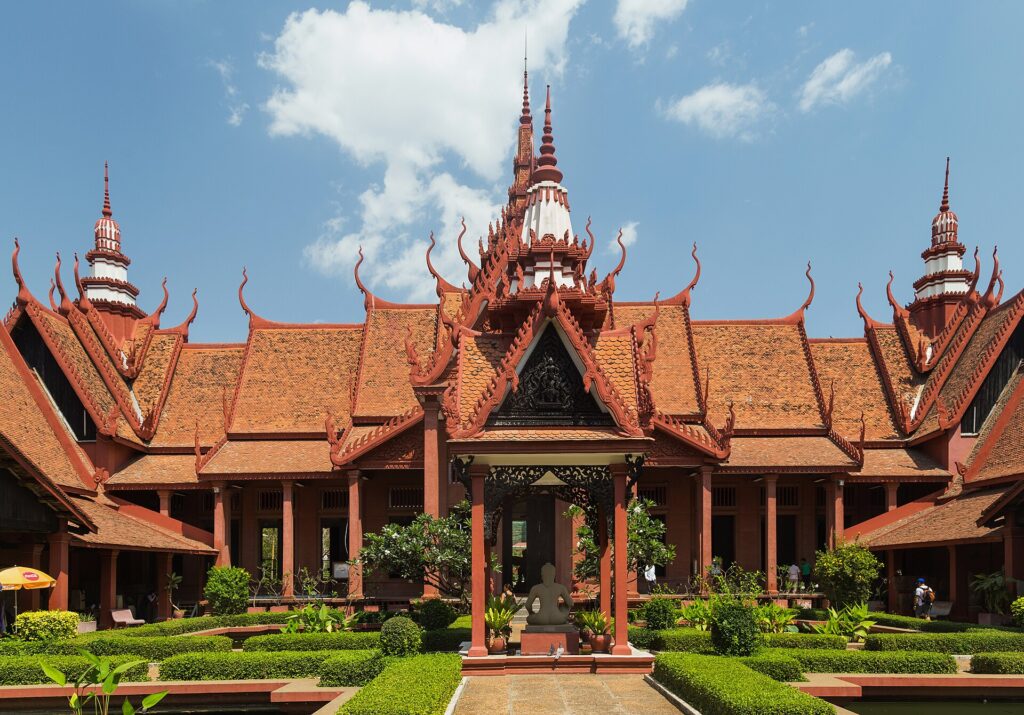
The National Museum of Cambodia in Phnom Penh holds the world's largest collection of Khmer art, more than 14,000 objects from prehistory to the post-Angkor period.…
Where
Corner of Street 13 and Street 178, beside the Royal Palace, Phnom Penh