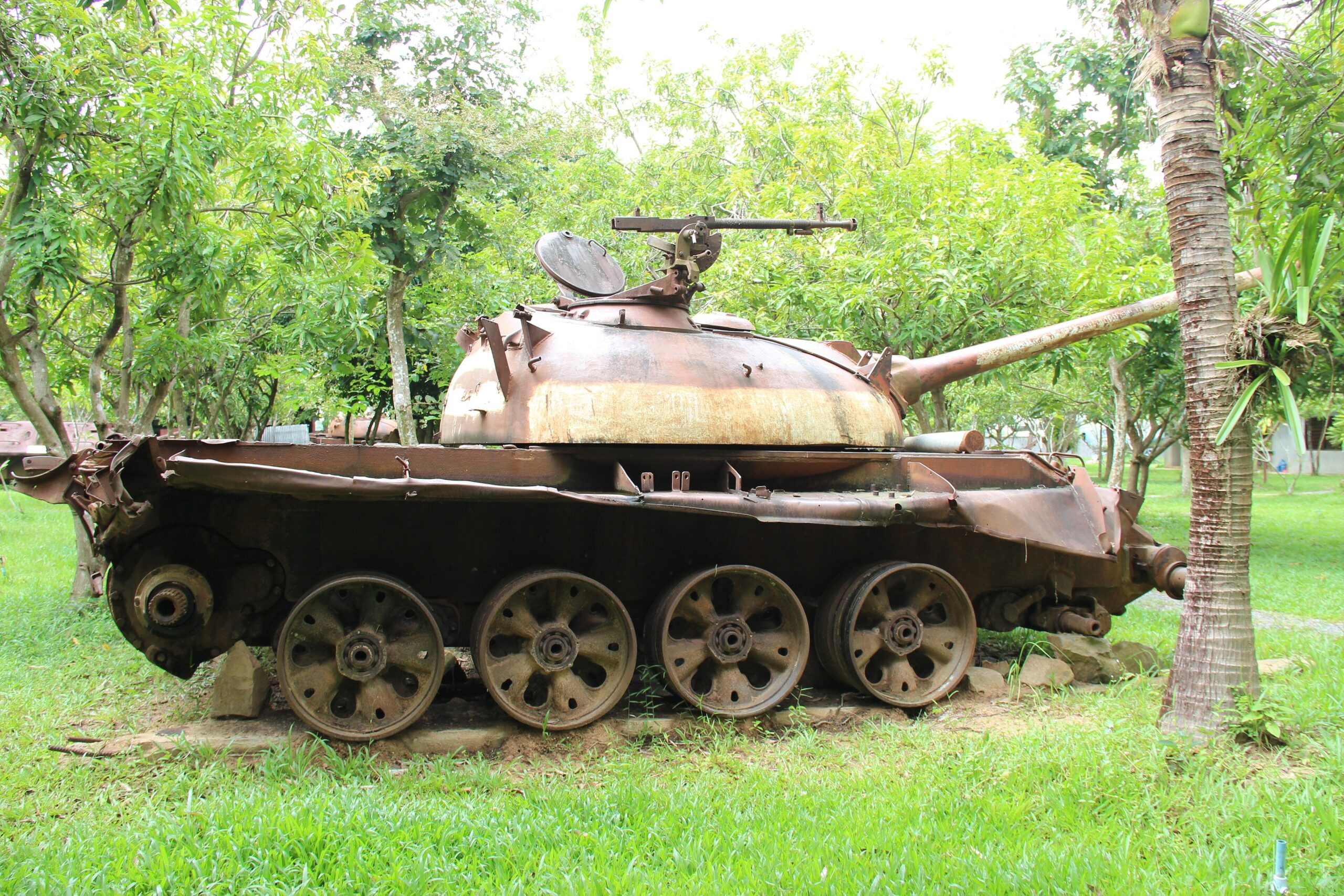
Soviet-made battle tank rusting among the trees at the War Museum Cambodia, Siem Reap, Cambodia
Siem Reap

War Museum Cambodia

Understanding modern Cambodia through the people who fought its wars

In short

The War Museum Cambodia is an open-air museum in Siem Reap displaying tanks, artillery, aircraft, weapons and landmines from Cambodia's wars between 1970 and the late 1990s. Its guides are veterans, many of them landmine survivors, who share their own experiences. It is open daily from 8:00 am to 5:30 pm, entry is $5 with a guide included, and a visit takes one to one and a half hours.

Checked

September 2026

Photo: Gary Todd from Xinzheng, China, via Wikimedia Commons (CC0)

Photos

Inside War Museum Cambodia

Soviet-made battle tank rusting among the trees at the War Museum Cambodia, Siem Reap, Cambodia Photo: Gary Todd from Xinzheng, China, via Wikimedia Commons (CC0)
Mil Mi-8 military helicopter on the lawn of the War Museum Cambodia, Siem Reap, Cambodia Photo: Gary Todd from Xinzheng, China, via Wikimedia Commons (CC0)
Shenyang J-6 jet fighter, a Chinese-built MiG-19, on display at the War Museum Cambodia, Siem Reap, Cambodia Photo: Gary Todd from Xinzheng, China, via Wikimedia Commons (CC0)
Display case of defused anti-personnel and anti-tank landmines, War Museum Cambodia, Siem Reap, Cambodia Photo: Gary Todd from Xinzheng, China, via Wikimedia Commons (CC0)
Rusting armoured personnel carrier in the grounds of the War Museum Cambodia, Siem Reap, Cambodia Photo: Gary Todd from Xinzheng, China, via Wikimedia Commons (CC0)
Truck-mounted multiple rocket launcher on display at the War Museum Cambodia, Siem Reap, Cambodia Photo: Gary Todd from Xinzheng, China, via Wikimedia Commons (CC0)

Swipe to see more photos

At a glance

Visiting

What it is
Open-air museum of military equipment from Cambodia's wars
Period covered
1970 to the late 1990s
Location
Off National Road 6 (airport road), western Siem Reap
From town
10 to 15 minutes by tuk-tuk
Opening hours
Every day, 8:00 am to 5:30 pm
Entry
$5 per person; confirm locally
Guides
Veterans, many of them landmine survivors; included in the ticket
Highlights
T-54 tanks, Mi-8 helicopter, J-6 jet fighter, landmine displays
Time needed
One to one and a half hours
Setting
Mostly outdoors in a shaded garden

The War Museum Cambodia in Siem Reap is an open-air collection of tanks, artillery, aircraft, weapons and landmines from the country’s three decades of conflict, from the civil war of the 1970s to the last years of the Khmer Rouge in the 1990s. Its guides are veterans, many of them landmine survivors, who share their own stories as they walk you round.

1970 to 1998Decades of conflict covered
$5Entry, guide included
1 to 1.5 hoursTime to allow
VeteransGuides who lived through the war

At first glance it looks like a garden of rusting machinery: tanks and armoured carriers half-hidden under mango trees, a helicopter and a fighter jet on the lawn. The objects are interesting, but the real value of the visit is the people. Walking round with a man who fought in these wars, and who may have lost a leg to a mine, turns old metal into history you will not forget.

Cambodia’s decades of war

Most visitors know about the Khmer Rouge years of 1975 to 1979. Fewer realise that Cambodia was at war, in one form or another, for almost thirty years. The museum covers that whole period, and the guides fill in what the labels leave out.

  1. 1969 to 1973
    American bombing of eastern Cambodia, aimed at Vietnamese supply routes, devastates the countryside.
  2. 1970
    Prince Norodom Sihanouk is overthrown. Civil war breaks out between the Lon Nol government and the Khmer Rouge.
  3. 1975 to 1979
    The Khmer Rouge rule Cambodia. Between 1.5 and 2 million people die.
  4. January 1979
    Vietnamese forces and Cambodian allies drive the Khmer Rouge from Phnom Penh. Fighting continues along the Thai border.
  5. 1980s
    Civil war between the new government and resistance groups, including the Khmer Rouge. Millions of landmines are laid.
  6. 1991 to 1993
    The Paris Peace Agreements and a UN-run transition lead to national elections in 1993.
  7. Late 1990s
    The last Khmer Rouge forces surrender or disband, and the long war finally ends.

Siem Reap province saw heavy fighting in this period, and parts of the Angkor area were front lines. Landmines left from these years have killed and injured many thousands of Cambodians since, and clearance continues today.

What you see at the museum

Most of the collection is outdoors, spread through a shaded garden, with a few open-sided sheds for smaller weapons and ordnance. Everything has been made safe.

Armour

Tanks and carriers

Soviet-made T-54 tanks and armoured personnel carriers, rusting where they stand. Some came from battlefields around the country.

Aircraft

Helicopter and jet

A Mil Mi-8 transport helicopter and a Shenyang J-6 fighter, the Chinese-built version of the MiG-19.

Artillery

Guns and rocket launchers

Field guns, anti-aircraft guns, mortars and truck-mounted rocket launchers used by the different armies of the period.

Landmines

The mine displays

Cases of defused anti-personnel and anti-tank mines, with explanations of how they were laid and why they are still so dangerous.

Small arms

Rifles and equipment

AK-47s, machine guns, helmets and field gear. Guides may let you hold some of the deactivated weapons.

Stories

Photographs and panels

Photographs and information boards on the wars, the landmine problem and the lives of those affected.

The veteran guides

The museum’s guides are former soldiers, and many are landmine survivors. Some fought for the government, some for the Khmer Rouge or other factions, and several served on more than one side over the years, as many Cambodians of their generation did.

A guide is included with your ticket. They explain the equipment, but the heart of the visit is their own experience: how they were recruited, what they saw, and how they rebuilt their lives. Ask questions gently and let them decide how much to share. A tip at the end is customary and much appreciated. For many of the guides, this work is also a way of making sure a younger generation of Cambodians, and visitors, do not forget.

Tickets and opening hours

Opening hours Every day, 8:00 am to 5:30 pm
Entry $5 per person; confirm locally
Guide Included in the ticket; tips welcome
Payment Cash, US dollars or riel
Time needed One to one and a half hours
Setting Mostly outdoors, on grass and unpaved paths

How to get there

The museum is on the western side of Siem Reap, a few hundred metres off National Road 6, the road towards the old airport. From the Old Market or Pub Street it is 10 to 15 minutes by tuk-tuk. PassApp and Grab both work well, and many tuk-tuk drivers will wait for you.

It fits neatly into an afternoon after a morning at the temples, or into a half-day in town combined with the memorial at Wat Thmey.

A half-day in modern Siem Reap

If you have seen enough temples for one day, this makes a thoughtful afternoon that shows a different side of the town:

  1. 2:00 pm War Museum Cambodia, about an hour with a veteran guide
  2. 3:30 pm APOPO Visitor Centre, to see how landmines are cleared today
  3. 4:45 pm Wat Thmey memorial, a short and quiet stop
  4. Evening Dinner in town, with plenty to talk about

Check APOPO’s tour times before you set off, as visits there run on a schedule. The three stops are all within a short tuk-tuk ride of each other.

Tips and etiquette

Our advice

  • Go in the morning or late afternoon. Most of the site is outdoors, and the midday heat is intense.
  • Wear sensible shoes. Paths are grassy and uneven, and can be muddy in the wet season.
  • Bring insect repellent. The garden setting means mosquitoes, especially after rain.
  • Carry small notes. For the ticket and a tip for your guide, and perhaps a donation or a book.
  • Bring children with care. Older children often find it fascinating, but explain beforehand that the guides may talk about injury and loss.
Please do

  • Listen to your guide’s story and ask before taking their photo
  • Remember that for your guide, this is real history
  • Tip your guide at the end
  • Stay on the paths through the garden
Please don’t

  • Treat the weapons as props for jokey photos
  • Climb on vehicles unless your guide says it is allowed
  • Press guides for details they do not want to share
  • Touch any object marked as off limits

Related places in Siem Reap

The APOPO Visitor Centre shows the other side of the landmine story: how trained rats help clear Cambodia’s remaining minefields. It makes a hopeful companion to the War Museum.

For the Khmer Rouge years themselves, the Wat Thmey memorial on the road to the temples is Siem Reap’s memorial to the victims. In Phnom Penh, the Tuol Sleng Genocide Museum and Choeung Ek tell that story in far greater depth.

Visiting with My Travel Factory

We often add the War Museum and APOPO to a slower day in Siem Reap, so that our guests leave with a sense of modern Cambodia as well as the temples. Both fit well into our Siem Reap Slow Travel and Phnom Penh & Angkor Discovery journeys. Tell us your interests and we will shape the day around them.

Questions travellers ask

Is the War Museum in Siem Reap worth visiting?
Yes, mainly for the veteran guides. Their personal stories give a side of Cambodian history most visitors never hear.
How much is the War Museum Cambodia entrance fee?
$5 per person, with a guide included. Confirm locally, and bring small notes for a tip.
What are the War Museum opening hours?
Every day from 8:00 am to 5:30 pm.
Is a guide included at the War Museum?
Yes. The guides are veterans, many of them landmine survivors, and a tip at the end is customary.
How long do you need at the War Museum Cambodia?
One to one and a half hours is enough to see the collection and talk with your guide.
Where is the War Museum in Siem Reap?
On the western side of town, a few hundred metres off National Road 6, the airport road, 10 to 15 minutes by tuk-tuk from the centre.
What can you see at the War Museum Cambodia?
Tanks, armoured vehicles, a helicopter, a jet fighter, artillery, rocket launchers, small arms and displays of defused landmines.
Is the War Museum suitable for children?
Older children usually find it interesting. Guides may talk about injury and loss, so prepare children beforehand.
Is the War Museum about the Khmer Rouge?
Partly. It covers the whole period of conflict from 1970 to the late 1990s, including the civil war, the Khmer Rouge years and the fighting that followed.
Can you hold the weapons at the War Museum?
Guides sometimes let visitors hold deactivated rifles. Please treat them with respect, as the history is very real for your guide.